What Checkpoint 3 covers in grade 5, items to try, the mistakes students make most, and the practice that goes with it.
Designed, reviewed, and checked by Greg · 25+ years in the classroom · Updated for 2026-27 · Window Feb 8 – Apr 9, 2027
7standards
140practice items
Nocalculator
What Checkpoint 3 covers
7 standards, 7 marked essential. Short names in our own words.
5.CA.5Multiply fractions with a modelEssential
5.CA.6Divide fractions with a modelEssential
5.CA.7Fraction multiplication in real-world problemsEssential
5.CA.8Fraction division in real-world problemsEssential
5.DA.1Line plots, histograms, and choosing a displayEssential
5.DA.2Mean, median, mode, and outliersEssential
5.M.3Area of triangles, parallelograms, and trapezoidsEssential
Try three items
Pick an answer to see the worked solution.
5.DA.1Approaching
Mr. Diaz asked 24 students to name their favorite school-lunch main dish. His results were pizza 9, tacos 7, pasta 5, and soup 3.
Which kind of data did Mr. Diaz collect, and which display fits it?
Choose an answer to see the worked solution.
Worked solutionThe answers Mr. Diaz collected are names of dishes, not measurements. Nothing about them can be added, put in order, or cut into equal intervals, and data made of names is categorical. A bar graph displays it: one bar for each name, with gaps between the bars because the categories have no width and no order. A histogram needs a numeric axis cut into equal intervals and a line plot needs a number line, so neither one has anywhere to put the word ‘tacos’. The four counts do add to 24, which confirms every student is represented once.
5.M.3Above Proficiency
A trapezoid-shaped tabletop has an area of 108 square inches and a height of 9 inches. Its longer parallel side is 4 inches longer than its shorter parallel side.
How long is each parallel side?
Choose an answer to see the worked solution.
Worked solutionFind the total of the two parallel sides before trying to find either one. Double the area: 108 × 2 = 216 square inches. Divide by the height: 216 ÷ 9 = 24 inches, so the two parallel sides add to 24. They differ by 4 inches. Take that difference off the total, 24 − 4 = 20, and split what is left evenly: 20 ÷ 2 = 10 inches for the shorter side, then 10 + 4 = 14 inches for the longer one. Checking both conditions: 10 + 14 = 24 and 14 − 10 = 4, and the area comes back as 12 × 9 = 108 square inches.
5.DA.1Above Proficiency
Dina asked 26 classmates to name their favorite pizza topping and got cheese 10, pepperoni 8, mushroom 5, and pineapple 3. She displayed the results as a histogram, with one bar for each topping and no gaps between the bars.
Which statement best explains what is wrong with Dina's display?
Choose an answer to see the worked solution.
Worked solutionA histogram's horizontal axis is a number line cut into equal intervals, and the WIDTH of each bar means something: it is the span of values that bar covers. Toppings have no numeric width and no order, so there is nothing for the axis to measure and nothing to decide which topping goes where. That is why a bar graph separates its bars — the gaps say the categories are not parts of a continuous scale. A line plot has the same problem, because it also needs a number line. Dina's counts do add to 26, so her data collection is fine; only her choice of display is wrong.
Where students go wrong
The most common mistake on each standard, and what to do about it, from the teacher pages in the Checkpoint 3 intervention.
5.CA.5
Multiplying the denominator as well as the numerator
What it looks like
5 × 23 comes back as 1015. The numerators are multiplied correctly and the denominator is multiplied too, so the answer is far too small — and it looks like a properly formed fraction, which is why it survives a glance.
What to do
Ask what the denominator is NAMING. Five groups of thirds are still thirds; the size of the piece did not change, only how many there are.
5.CA.6
Multiplying because dividing "would make it smaller"
What it looks like
3 ÷ 34 answered as 94. The student rejects the division because they expect a smaller answer, then multiplies instead and reports something under 3 when the true quotient is 4.
What to do
Reword it as "how many three-quarters fit in 3?" The counting question has no size expectation attached to it.
5.CA.7
Multiplying only the whole-number part
What it looks like
3 batches of 213 cups reported as 6 cups. The fraction is dropped silently, so the answer is always a whole number and always slightly too small.
What to do
Convert to an improper fraction before multiplying, or multiply the whole and the fraction separately and add both — but never just the whole.
5.CA.8
Multiplying when the situation divides
What it looks like
"How many servings of 23 cup are in 83 cups" answered by multiplying the two fractions. The result is under 2 when the real answer is 4, and it is reported without a size check.
What to do
Servings, bags, pieces, how many fit — all of these count groups inside a total, and counting groups is division.
5.DA.1
Including the values that sit exactly on the boundary
What it looks like
"Longer than 112 feet" answered by counting the ribbons AT 112 as well. The reading of the plot is perfect and the inequality is not.
What to do
Underline the comparison word before touching the plot. "Longer than" and "at least" select different marks.
5.DA.2
Swapping median and mode
What it looks like
The most frequent value reported as the median and the middle value as the mode. Both numbers are right; both labels are wrong, so a student who knows the procedures still scores zero.
What to do
Mode and most start the same way. Median is the middle, like the median of a road.
5.M.3
Halving a parallelogram's area
What it looks like
Base × height × 12 applied to a parallelogram, giving half the right answer — or, working backwards from a given area, twice the right dimension.
What to do
Two triangles make the parallelogram, so the parallelogram already IS the doubled one. Only the triangle halves.
Get the Checkpoint 3 practice
Free
Try it first
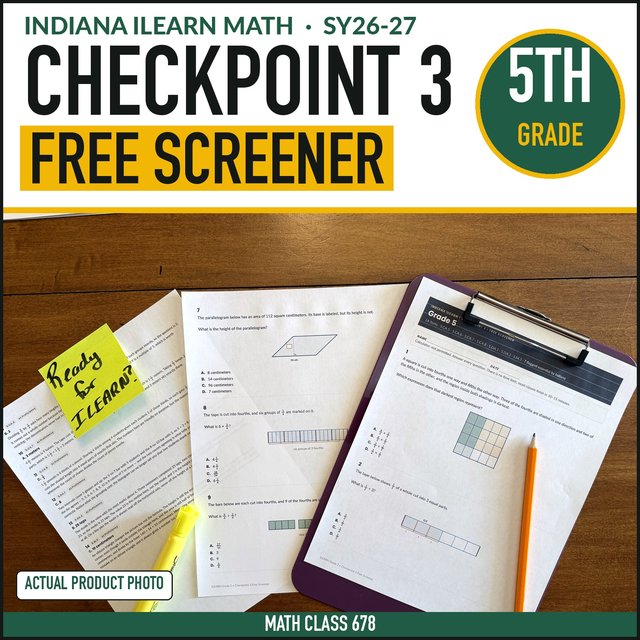
The grade 5 screener: two items per standard, a class tracker and a page that says where each student goes next.
Press play for a 20-second look at the real pages.
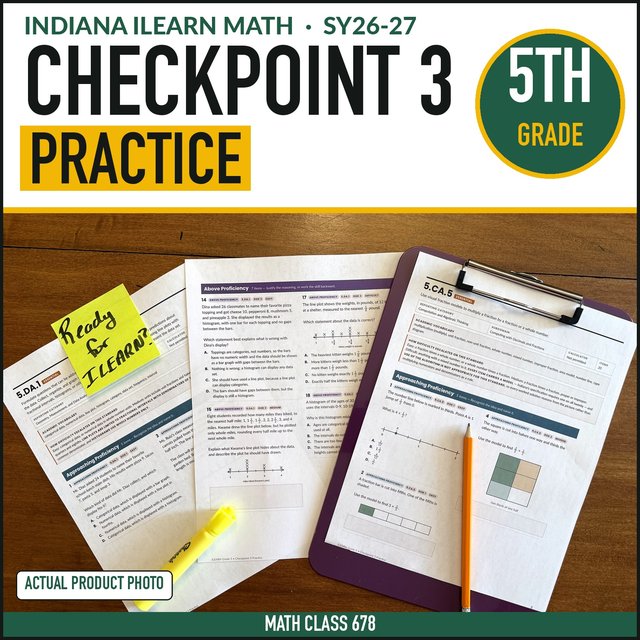
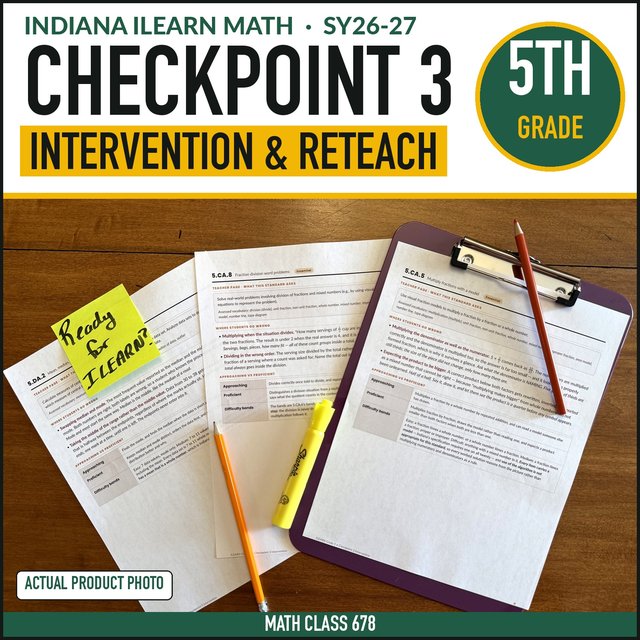
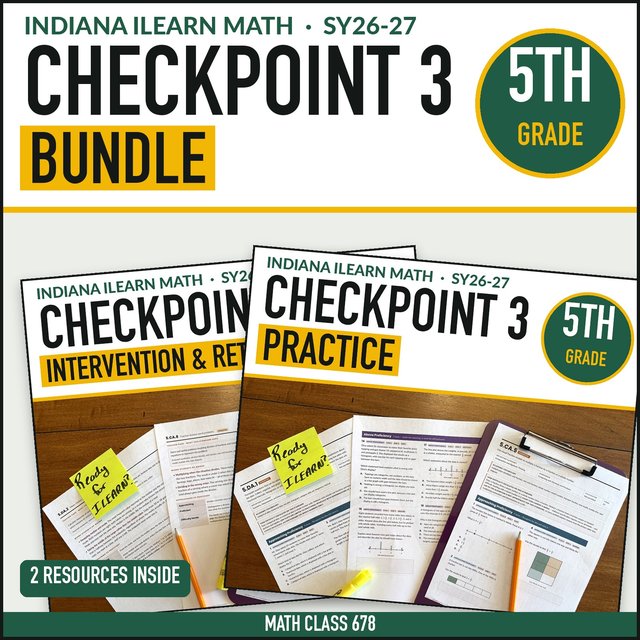
Checkpoint 3 PracticeBefore the window opensCheckpoint 3 Intervention & ReteachFor after the checkpointCheckpoint 3 BundlePractice and reteach together
Independent practiceIndependent practice for the Indiana ILEARN Math assessment. Not affiliated with, sponsored by, or endorsed by the Indiana Department of Education. Standard names are short summaries in our own words; see IDOE for the official text.