What Checkpoint 3 covers in grade 4, items to try, the mistakes students make most, and the practice that goes with it.
Designed, reviewed, and checked by Greg · 25+ years in the classroom · Updated for 2026-27 · Window Feb 8 – Apr 9, 2027
7standards
140practice items
Nocalculator
What Checkpoint 3 covers
7 standards, 5 marked essential. Short names in our own words.
4.CA.6Add and subtract fractions with like denominatorsEssential
4.CA.8Fraction problems in real-world settingsEssential
4.DA.1Line plots, bar graphs, and frequency tablesEssential
4.DA.2Line plots with fractional measurements
4.NS.2Model mixed numbers and improper fractions
4.NS.5Tenths and hundredths as fractions and decimalsEssential
4.NS.6Compare decimals to hundredthsEssential
Try three items
Pick an answer to see the worked solution.
4.DA.2Approaching
A student measured 9 leaves, in inches:
34, 12, 34, 1, 14, 34, 12, 114, 34
The student is making a line plot marked in quarters. How many x marks belong above 34?
Choose an answer to see the worked solution.
Worked solutionA line plot gets one x mark for every measurement in the data set, placed above the tick that names that measurement. Reading through the list and counting only the leaves that measured 34 inch gives 4 of them, so 4 x marks belong above 34. The value 9 is the number of leaves, which is also how many marks the finished plot will hold altogether, 2 counts the leaves that measured 12 inch, and 1 counts the single leaf that measured 14 inch.
4.CA.6At Proficiency
What is the value of 18 + 28 + 38?
Choose an answer to see the worked solution.
Worked solutionThree amounts can be joined the same way two can, as long as every one of them counts pieces of the same size, and all three of these count pieces of size 18. Gathering them gives 1 + 2 + 3 = 6 pieces, which is 68. The other values each come from gathering only part of the expression: 58 joins 28 and 38 and forgets the unit fraction, 48 joins 18 and 38, and 38 is the largest amount in the expression left standing on its own.
4.CA.8Above Proficiency
A painter used 710 gallon of paint on a wall and 610 gallon of the same paint on a ceiling.
How much paint did the painter use in all?
Choose an answer to see the worked solution.
Worked solutionThis is a Put Together problem with the total unknown. Both amounts are measured in gallons of the same paint, so they count pieces of size 110 gallon: 7 pieces plus 6 pieces gives 13 of them, or 1310 gallons. Since 10 of those pieces make a whole gallon, 13 of them is 1 gallon with 3 pieces beyond it, which is 1310 gallons. The value 13100 comes from multiplying the denominators while adding the numerators, and it fails an easy check, since it is far smaller than either amount used. The value 1110 carries a whole gallon out of the 13 pieces but leaves only 1 piece behind instead of 3, and 110 gallon is the difference of the two amounts rather than their total.
Where students go wrong
The most common mistake on each standard, and what to do about it, from the teacher pages in the Checkpoint 3 intervention.
4.CA.6
Adding the denominators as well as the numerators
What it looks like
18 + 38 answered as 416. Both parts are added, so the answer is smaller than either fraction started — and it still looks like a fraction, which is why it survives a glance.
What to do
The denominator NAMES the piece; it is not a quantity being added. One eighth plus three eighths is four EIGHTHS, the same way one cat plus three cats is four cats. Say the name out loud while adding and the denominator stops moving.
4.CA.8
Answering with the running total instead of the question
What it looks like
A recipe needs 78 cup and 38 is already in; the student answers 78, or adds to get 128. The arithmetic is fine and the question asked how much MORE.
What to do
Underline the question sentence before computing anything, and check the final answer against it rather than against your own working. “How much more” is a subtraction, however many numbers the story contains.
4.DA.1
Reading a frequency as a value, or a value as a frequency
What it looks like
A table showing 5 boxes with 10 pencils each answered as 5 when the question asked for pencils. Both numbers are in the table and the wrong one is the one the eye lands on.
What to do
Say what each column counts before reading anything off. One column counts THINGS and one counts HOW MANY TIMES. Point at the column the question wants and cover the other one.
4.DA.2
Scaling the axis in whole units when the data are fractions
What it looks like
Ten measurements in eighths plotted on an axis marked 0, 1, 2, so every value piles onto one or two marks and the plot shows nothing.
What to do
The axis has to carry the SAME unit as the measurements. If the data are eighths, mark every eighth. Find the smallest and largest value first, then mark every step between them before plotting a single x.
4.NS.2
Reading a mixed number as two separate numbers
What it looks like
314 renamed in fourths as 14 with the 3 ignored, or as 44 by adding 3 and 1. The whole number is treated as decoration rather than as part of the amount.
What to do
A mixed number is ONE amount: 3 wholes AND a quarter. Change the wholes into fourths first — 3 wholes is 12 fourths — then add the quarter already there: 13 fourths.
4.NS.5
Naming the decimal place by the number of digits, not the place
What it looks like
0.07 called seven tenths or 710. The student sees one number after the point and reaches for tenths without checking which column the 7 is in.
What to do
Point at the digit and name its column: tenths, then hundredths. The 0 in the tenths column is doing real work — it says there are no tenths, so the 7 is hundredths: 7100.
4.NS.6
Comparing the digits after the point as whole numbers
What it looks like
0.08 called greater than 0.8, because 8 is compared with 8 and the longer number is assumed to be the larger — the same habit that makes 0.25 look bigger than 0.7.
What to do
Line the decimal points up and pad with zeros so both have the same number of places: 0.80 against 0.08. Now the tenths column decides, and 8 tenths clearly beats 0 tenths.
Get the Checkpoint 3 practice
Free
Try it first
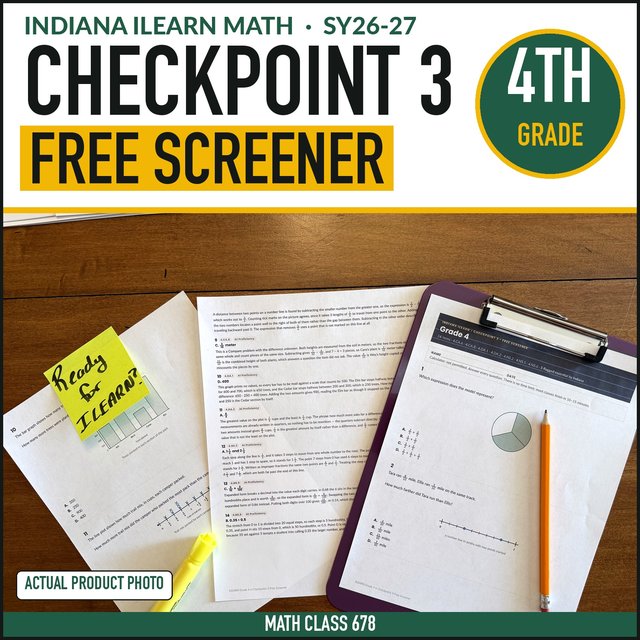
The grade 4 screener: two items per standard, a class tracker and a page that says where each student goes next.
Press play for a 20-second look at the real pages.
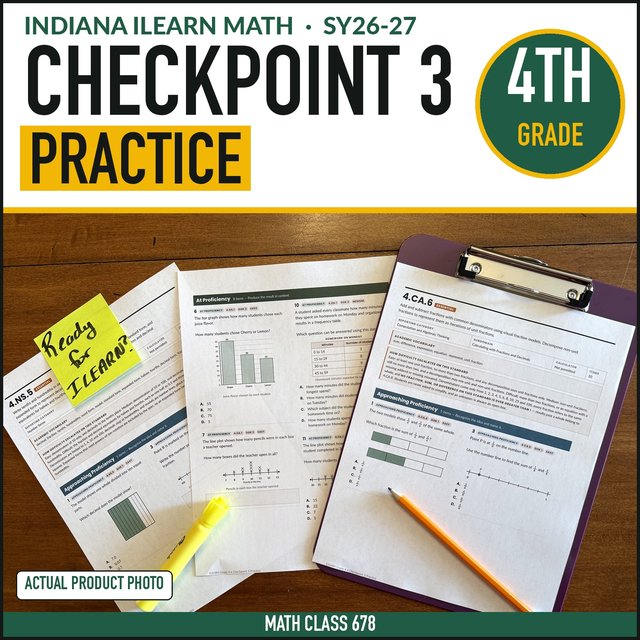
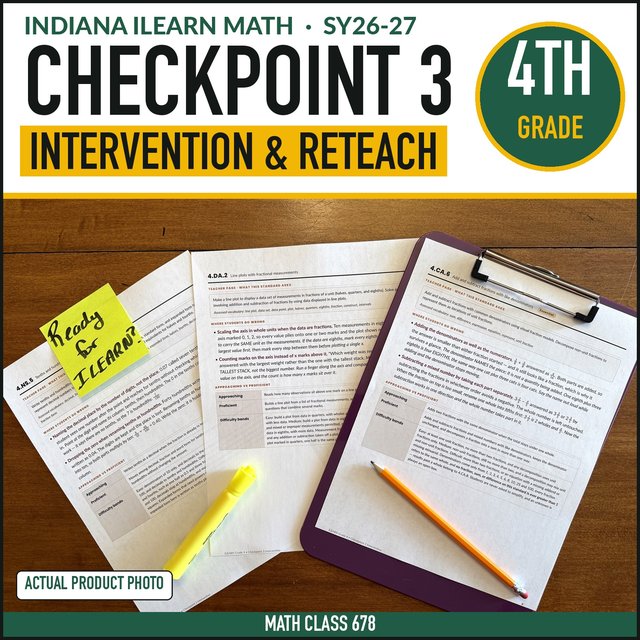
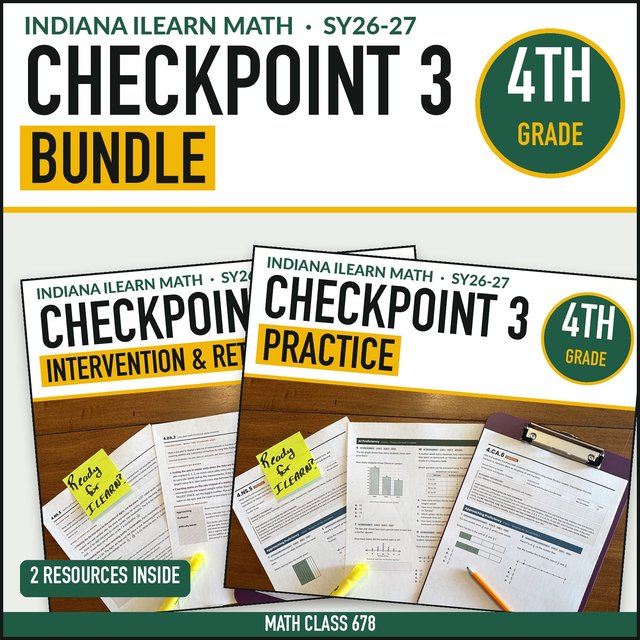
Checkpoint 3 PracticeBefore the window opensCheckpoint 3 Intervention & ReteachFor after the checkpointCheckpoint 3 BundlePractice and reteach together
Independent practiceIndependent practice for the Indiana ILEARN Math assessment. Not affiliated with, sponsored by, or endorsed by the Indiana Department of Education. Standard names are short summaries in our own words; see IDOE for the official text.