What Checkpoint 2 covers in grade 4, items to try, the mistakes students make most, and the practice that goes with it.
Designed, reviewed, and checked by Greg · 25+ years in the classroom · Updated for 2026-27 · Window Nov 16 – Feb 5, 2027
7standards
140practice items
Nocalculator
What Checkpoint 2 covers
7 standards, 7 marked essential. Short names in our own words.
4.CA.2Divide up to four digits by one digitEssential
4.CA.5Multiplicative comparison problemsEssential
4.M.1Measure to the nearest quarter- and eighth-inchEssential
4.M.2Convert larger units to smaller unitsEssential
4.M.4Area and perimeter, including complex shapesEssential
4.NS.3Generate equivalent fractionsEssential
4.NS.4Compare fractionsEssential
Try three items
Pick an answer to see the worked solution.
4.CA.2Approaching
A student divides and gets 552 ÷ 4 = 138.
Which multiplication equation can be used to check that answer?
Choose an answer to see the worked solution.
Worked solutionMultiplication undoes division, so a division answer is checked by multiplying the quotient by the divisor and seeing whether the dividend comes back. Here that is 138 × 4, which is 552 — the number the student started with, so the quotient is right. Multiplying the dividend by the divisor, or adding instead of multiplying, does not undo the division.
4.CA.5At Proficiency
A school has 18 teachers. It has 12 times as many students as teachers.
How many students does the school have?
Choose an answer to see the worked solution.
Worked solutionTwelve times as many means 12 groups of 18 students. Splitting the multiplication, 10 × 18 is 180 and 2 × 18 is 36, and 180 + 36 = 216 students. Adding 12 and 18 gives 30, which would answer a "how many more" question instead.
4.NS.3Above Proficiency
Which fraction is equivalent to 114?
Choose an answer to see the worked solution.
Worked solutionOne whole is 4 fourths, and the mixed number has one more fourth on top of it, so 114 is 4 + 1 = 5 fourths, which is 54. Writing the whole number and the numerator side by side gives 114, which is nearly 3 wholes, and swapping the numerator and denominator gives a number less than 1.
Where students go wrong
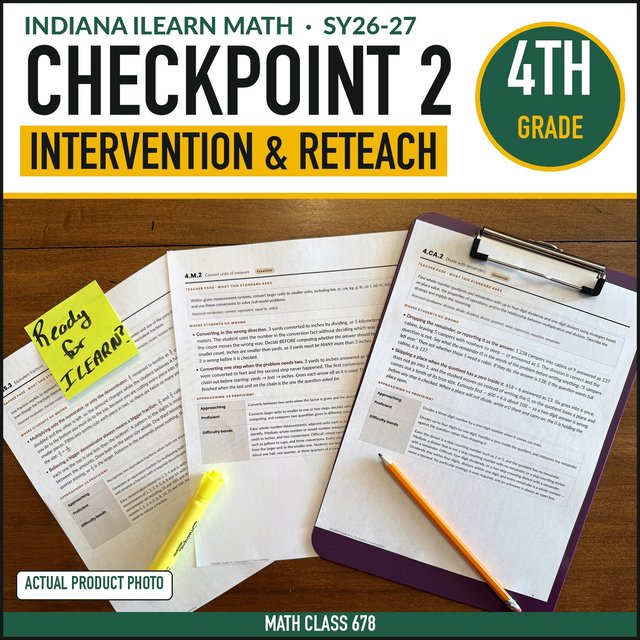
The most common mistake on each standard, and what to do about it, from the teacher pages in the Checkpoint 2 intervention.
4.CA.2
Dropping the remainder, or reporting it as the answer
What it looks like
1,238 campers into cabins of 9 answered as 137 cabins, leaving 5 campers with nowhere to sleep — or answered as 5. The division is correct and the question is not.
What to do
Say what the remainder IS in the words of the problem before writing anything: “5 campers left over.” Then ask whether those 5 need a cabin. If they do, the answer is 138; if the question wants full cabins, it is 137.
4.CA.5
Reading “times as many” as “more than”
What it looks like
“I have 36 cards and Rae has 9, so I have 27 times as many.” The student subtracts and attaches the multiplicative words to an additive answer.
What to do
Ask “how many of the small amount fit inside the big one?” Nine fits into 36 four times, so 4 times as many. Difference answers “how many more”; division answers “how many times”, and the two questions have different answers on the same pair of numbers.
4.M.1
Reading the number the object ends at, when it did not start at 0
What it looks like
A pencil lying from 1 to 358 on the ruler reported as 358 inches. The student reads the end mark instead of measuring the distance covered.
What to do
Length is the DISTANCE between the two ends, so subtract: end minus start. Put a finger on each end and count the inches between them; if the object starts at 0 the subtraction is invisible, which is why starting anywhere else breaks it.
4.M.2
Converting in the wrong direction
What it looks like
3 yards converted to inches by dividing, or 5 kilometers called 500 meters. The student uses the number in the conversion fact without deciding which way it points, so the count moves the wrong way.
What to do
Decide BEFORE computing whether the answer should be a bigger or a smaller count. Inches are smaller than yards, so 3 yards must be MANY more than 3 inches. Any answer under 3 is wrong before it is checked.
4.M.4
Computing area when the question asks for perimeter, or the reverse
What it looks like
A 14 by 6 garden answered as 40 when the question asked for area, or 84 when it asked for perimeter. Both numbers come from the same two side lengths, so neither looks obviously wrong.
What to do
Read the UNIT the question wants. Square feet means covering the inside, so multiply. Feet means going around the edge, so add all four sides. Writing the unit down before computing decides the operation.
4.NS.3
Multiplying only the numerator, or only the denominator
What it looks like
45 renamed in tenths as 85 or 410. One part is doubled and the other is left, so the amount changes while the student believes it has not.
What to do
Whatever you do to the bottom you must do to the top, because you are cutting every piece into the same number of smaller pieces. Fifths into tenths cuts each piece in two, so there are twice as many pieces AND each is half the size: 45 = 810.
4.NS.4
Comparing by the numerator alone
What it looks like
410 called greater than 35 because 4 is greater than 3. The count of parts is compared while the size of a part is ignored.
What to do
A numerator counts parts; the denominator says how big each part is. Rename both to the same unit before comparing: 35 = 610, and 6 tenths beats 4 tenths. Until the units match, the numerators are not comparable.
Get the Checkpoint 2 practice
Free
Try it first
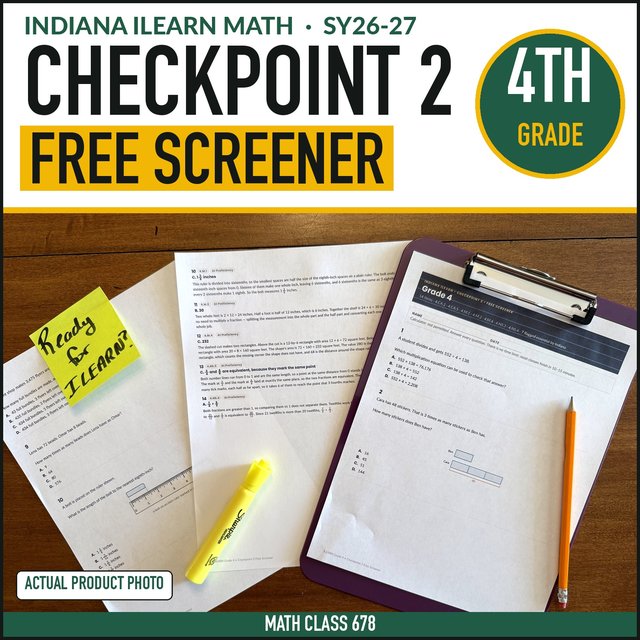
The grade 4 screener: two items per standard, a class tracker and a page that says where each student goes next.
Press play for a 20-second look at the real pages.
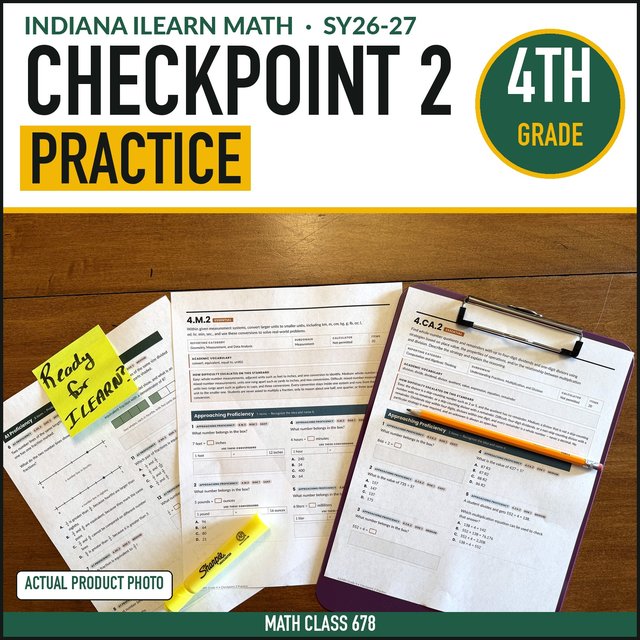
Checkpoint 2 PracticeBefore the window opensCheckpoint 2 Intervention & ReteachFor after the checkpointCheckpoint 2 BundlePractice and reteach together
Independent practiceIndependent practice for the Indiana ILEARN Math assessment. Not affiliated with, sponsored by, or endorsed by the Indiana Department of Education. Standard names are short summaries in our own words; see IDOE for the official text.