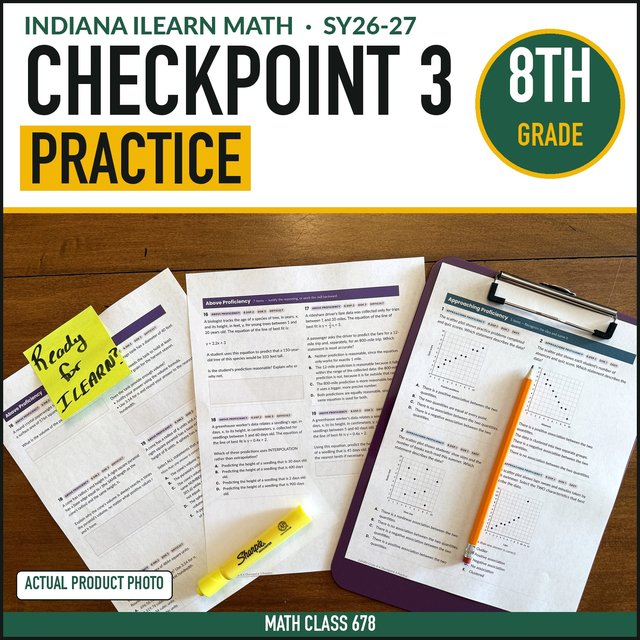
What Checkpoint 3 covers in grade 8, items to try, the mistakes students make most, and the practice that goes with it.
Designed, reviewed, and checked by Greg · 25+ years in the classroom · Updated for 2026-27 · Window Feb 8 – Apr 9, 2027
5standards
100practice items
Yescalculator
What Checkpoint 3 covers
5 standards, 4 marked essential. Short names in our own words.
8.DSP.1Scatter plots: clustering, outliers, and association
8.DSP.2Line of best fit: interpret slope and y-intercept in contextEssential
8.GM.1Dilations, translations, rotations, reflections in the coordinate planeEssential
8.GM.2Volume of cones, spheres, pyramids; surface area of spheresEssential
8.GM.3The Pythagorean Theorem, including the 3-D box diagonalEssential
Try three items
Pick an answer to see the worked solution.
8.GM.2At Proficiency
An ice cream shop sells waffle cones shaped like a cone, with a radius of 6 cm and a height of 14 cm.
What is the volume of one cone? Use 3.14 for π. Round your answer to the nearest hundredth.
Choose an answer to see the worked solution.
Worked solutionV = 13πr²h = 13(3.14)(6²)(14) = 13(3.14)(36)(14) = 527.52 cm³. 1,582.56 comes from forgetting the 13 factor (using the full cylinder formula instead); 168.00 leaves π out entirely; 1,230.88 swaps the radius and height.
8.GM.1Above Proficiency
A triangle is dilated by a scale factor of 3, centered at the origin, to create a larger, similar triangle.
Which attribute of the triangle changes as a result of the dilation?
Choose an answer to see the worked solution.
Worked solutionA dilation produces a SIMILAR figure: angle measures and the overall shape stay exactly the same, but every length is scaled by the scale factor -- here, 3 times as long.
8.DSP.2At Proficiency
A gym tracks a member's number of visits per month, x, and their monthly membership cost after a discount program, y, in dollars. The equation of the line of best fit is:
y = -1.5x + 60
Which statement describes the rate of change modeled by the equation?
Choose an answer to see the worked solution.
Worked solutionThe slope is -1.5, which is negative: the cost (y) DECREASES by $1.50 for each additional visit (x) -- consistent with a discount program that rewards more visits.
Where students go wrong
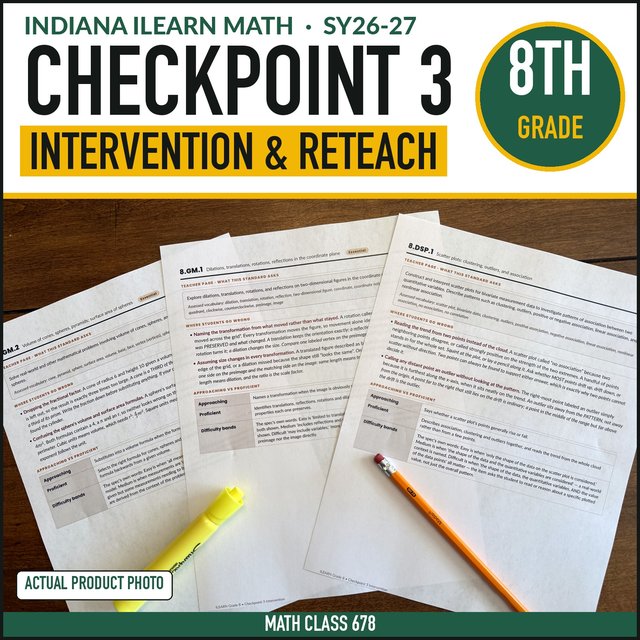
The most common mistake on each standard, and what to do about it, from the teacher pages in the Checkpoint 3 intervention.
8.DSP.1
Reading the trend from two points instead of the cloud
What it looks like
A scatter plot called “no association” because two neighboring points disagree, or called strongly positive on the strength of the two extremes. A handful of points stands in for the whole set.
What to do
Squint at the plot, or lay a pencil along it. Ask whether MOST points drift up, drift down, or scatter without direction. Two points can always be found to support either answer, which is exactly why two points cannot decide it.
8.DSP.2
Reporting the slope as a bare number
What it looks like
“The slope is 2.5” with no units, when the question asked what it means for the situation. The arithmetic is right and the interpretation is missing.
What to do
Say the slope as a sentence with both units: “each extra mile adds $2.50 to the fare.” Write the units of x and y down before touching the number, and the sentence writes itself.
8.GM.1
Naming the transformation from what moved rather than what stayed
What it looks like
A rotation called a translation because “it moved across the grid”. Every transformation moves the figure, so movement alone identifies none of them.
What to do
Ask what was PRESERVED and what changed. A translation keeps the orientation exactly; a reflection produces a mirror image; a rotation turns it; a dilation changes the size. Compare one labeled vertex on the preimage with its partner on the image.
8.GM.2
Dropping the fractional factor
What it looks like
A cone of radius 6 and height 10 given a volume of 360π — the cylinder answer. The 13 is left out, so the result is exactly three times too large.
What to do
A cone is a THIRD of the cylinder that contains it, and a pyramid is a third of its prism. Write the fraction down before substituting anything. If your cone answer equals πr2h exactly, you have found the cylinder.
8.GM.3
Taking the last length given to be the hypotenuse
What it looks like
A triangle with a leg of 9 and a hypotenuse of 41 answered with √(92 + 412) ≈ 42. Both given lengths are added as though they were legs, so a missing LEG is computed as a hypotenuse.
What to do
The hypotenuse is the LONGEST side and sits opposite the right angle — never decided by where it appears in the sentence. Label c first, then choose: legs missing means subtract, hypotenuse missing means add. Here 412 − 92 = 1,600, so the leg is 40.
Get the Checkpoint 3 practice
Free
Try it first
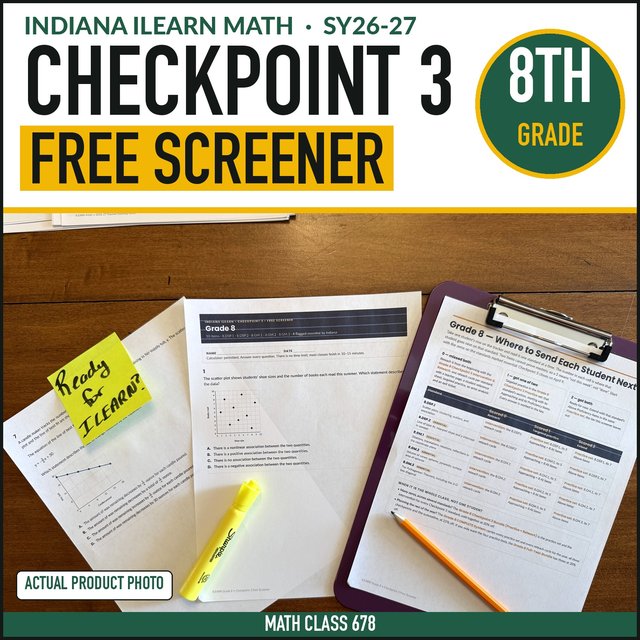
The grade 8 screener: two items per standard, a class tracker and a page that says where each student goes next.
Press play for a 20-second look at the real pages.
Checkpoint 3 PracticeBefore the window opensCheckpoint 3 Intervention & ReteachFor after the checkpointCheckpoint 3 BundlePractice and reteach together
Independent practiceIndependent practice for the Indiana ILEARN Math assessment. Not affiliated with, sponsored by, or endorsed by the Indiana Department of Education. Standard names are short summaries in our own words; see IDOE for the official text.