8.AF.5y = mx + b defines a linear function; linear vs. nonlinear
8.AF.6Construct a linear function; interpret rate of change and y-interceptEssential
8.AF.7Compare two linear functions in different representations
8.AF.8Approximating a system's solution by graphingEssential
Try three items
Pick an answer to see the worked solution.
8.AF.8Approaching
A system of equations is given.
y = 2x + 3 2y = 4x + 6
What is the solution to this system?
Choose an answer to see the worked solution.
Worked solutionDividing the second equation by 2 gives y = 2x + 3, which is identical to the first equation. Both equations describe the exact same line, so every point on that line is a solution — the system has infinitely many solutions, even though the two equations do not look identical at first glance.
8.AF.6At Proficiency
A weather balloon's height is tracked after launch. At sea level (its launch point) it begins climbing at a rate of 12.5 meters per minute. Which equation models the balloon's height, y, in meters, after x minutes?
Choose an answer to see the worked solution.
Worked solution"At sea level" is the context's way of stating the y-intercept without a number: sea level is height 0, so b = 0 and the y-intercept is understood from context rather than given as a stated amount — the hallmark of this standard's Difficult band. The rate of change is the given climbing rate, 12.5 meters per minute. In y = mx + b form with b = 0, that is y = 12.5x.
8.AF.3Above Proficiency
A vending machine dispenses a bag of chips for every dollar inserted, but a jam in the machine sometimes drops two bags for a single dollar. On one afternoon, the machine's record shows: $1 → 1 bag, $2 → 1 bag, $1 → 2 bags, $3 → 1 bag.
Which statement about this relation is true?
Choose an answer to see the worked solution.
Worked solutionThe independent variable is the amount inserted, and the dependent variable is the number of bags dispensed. The input $1 is recorded with two different outputs, 1 bag and 2 bags, on the two occasions it was inserted. Because that one input maps to more than one output, the relation is not a function — a jammed machine is exactly the kind of real-world situation that breaks the function property, which is why it makes a useful example rather than a reason to exclude it.
Where students go wrong
The most common mistake on each standard, and what to do about it, from the teacher pages in the Checkpoint 2 intervention.
8.AF.3
Checking the outputs instead of the inputs
What it looks like
{(1, 4), (2, 7), (1, 9), (3, 4)} called a function because “the 4 repeats and that is fine”, or called NOT a function for that same reason. The rule is applied to the y-values.
What to do
The rule is about INPUTS: each x may appear only once. Circle the x-values and look for a repeat — here 1 appears twice with two different partners, so it is not a function. A repeated y is always allowed.
8.AF.4
Describing a graph by where it ends rather than how it moves
What it looks like
A candle burning down described as “constant” because the line is straight, or as “increasing” because time moves forward. The shape is read from the wrong axis or the wrong feature.
What to do
Put a finger on the left of the graph and trace RIGHT. Ask only: is the line going up, going down, or staying level? A straight line that falls is decreasing AND linear — those are two separate descriptions and both are true.
8.AF.5
Judging by whether an x is visible
What it looks like
y = 3 called nonlinear because it has no x. The student looks for the letter rather than for the form.
What to do
y = 3 is y = 0x + 3 — a linear function with a slope of zero, and its graph is a horizontal line. Ask whether the equation CAN be written as y = mx + b, not whether an x is showing.
8.AF.6
Swapping the rate and the starting amount
What it looks like
“$45 saved, $9 added each week” modeled as y = 45x + 9. The two numbers appear in the order the sentence gives them, so the sentence order becomes the equation order.
What to do
Ask which amount happens ONCE and which happens EVERY time. The repeating one is the rate and attaches to x; the one-off is the starting value. Test at x = 0: with y = 9x + 45 you start at $45, which matches the story.
8.AF.7
Comparing on whichever feature is easiest to see
What it looks like
y = 5x + 2 and y = 3x + 2 compared with “they are the same, both have +2” when the question asked about rate of change. The matching feature is reported instead of the one asked about.
What to do
Underline the feature the question names — rate of change, or initial value — and mark it in BOTH representations before comparing. The other feature matching is not the answer to a question about this one.
8.AF.8
Calling two equations of the same line “no solution”
What it looks like
y = 2x + 3 and 2y = 4x + 6 reported as no solution, because the equations look different. Dividing the second by 2 gives the first, so every point on the line solves both.
What to do
Put both equations in y = mx + b form BEFORE deciding anything. Identical equations mean one line drawn twice, so there are infinitely many solutions. Different intercepts with the same slope mean parallel lines and no solution.
Get the Checkpoint 2 practice
Free
Try it first
The grade 8 screener: two items per standard, a class tracker and a page that says where each student goes next.
Press play for a 20-second look at the real pages.
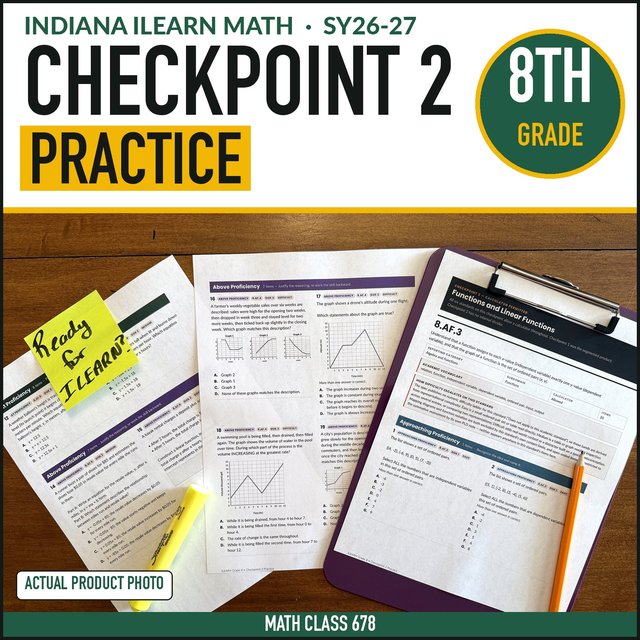
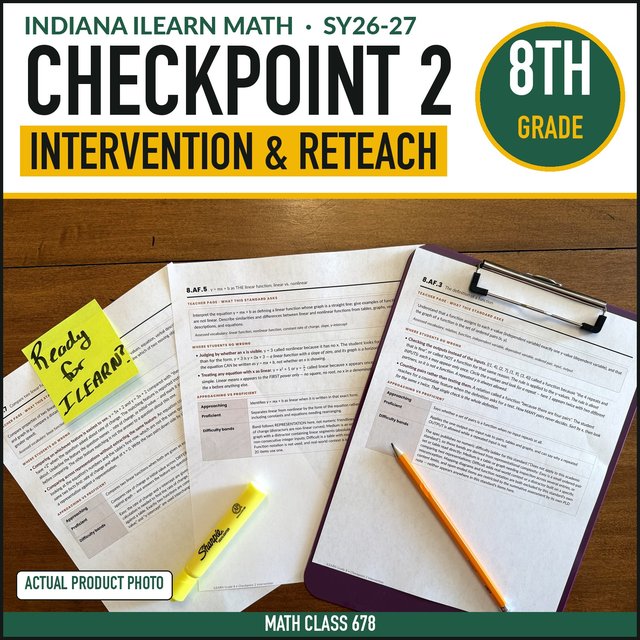
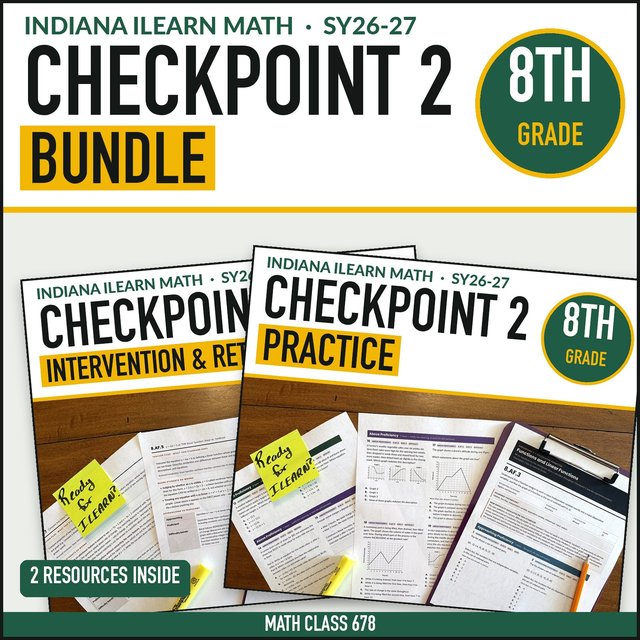
Checkpoint 2 PracticeBefore the window opensCheckpoint 2 Intervention & ReteachFor after the checkpointCheckpoint 2 BundlePractice and reteach together
Independent practiceIndependent practice for the Indiana ILEARN Math assessment. Not affiliated with, sponsored by, or endorsed by the Indiana Department of Education. Standard names are short summaries in our own words; see IDOE for the official text.