Grade 7 ILEARN Math Checkpoint 2 Practice

What Checkpoint 2 covers in grade 7, items to try, the mistakes students make most, and the practice that goes with it.

6standards
120practice items
Yescalculator

What Checkpoint 2 covers

6 standards, 3 marked essential. Short names in our own words.

  • 7.RP.1Identify the unit rate or constant of proportionality
  • 7.RP.2Percent problems: tax, tip, markup, interestEssential
  • 7.RP.3Equations and graphs of proportional relationshipsEssential
  • 7.AF.5Constant and varying rates of change
  • 7.AF.6Slope from a graph; graphing from slope and a pointEssential
  • 7.GM.1Scale drawings, actual lengths and areas

Try three items

Pick an answer to see the worked solution.

7.GM.1Approaching

A scale drawing of a polygon is enlarged to make the actual figure, using a scale factor of 5. One side in the drawing is 7 units long.

How long is the matching side of the actual figure?

Choose an answer to see the worked solution.

7.RP.2At Proficiency

A shop buys a bicycle from a supplier for $180 and marks up the price 45% before selling it.

What is the selling price?

Choose an answer to see the worked solution.

7.AF.5Above Proficiency

Two machines each work at a constant rate. Machine A produces 240 items in 8 hours. Machine B produces 210 items in 6 hours.

Which machine has the greater rate of change, and what is that rate?

Choose an answer to see the worked solution.

Where students go wrong

The most common mistake on each standard, and what to do about it, from the teacher pages in the Checkpoint 2 intervention.

7.RP.1

Reading a single y-value as the constant

What it looks like
A table pairing 4 hours with 18 dollars answered with k = 18. The student reports the y that happens to be in front of them rather than dividing it by its x.
What to do
k is always y ÷ x, and it is the y-value when x is 1. Compute it from EVERY row and check the answers match — that is also the test for whether the relationship is proportional at all.
7.RP.2

Taking the percent of the wrong base

What it looks like
A price rising from $40 to $46 called a 13% increase, because the $6 rise was divided by the NEW price. The arithmetic is right and the base is wrong, so the answer is always a little too small.
What to do
Percent change is always measured against what you STARTED with. Underline the original amount before dividing: 6 ÷ 40 = 0.15, so 15%. Dividing by the new amount answers a question nobody asked.
7.RP.3

Writing the equation upside down

What it looks like
A printer doing 5 pages in 2 minutes modeled as y = 0.4x, or as y = x/2.5. The student has the right two numbers and divides them the wrong way round.
What to do
Say the sentence “___ per ___” out loud first. Pages per minute is 5 ÷ 2 = 2.5, so y = 2.5x. Test it with one minute: 2.5 pages, which is sensible; y = 0.4x would give under half a page a minute.
7.AF.5

Computing the rate from one row instead of a difference

What it looks like
A table starting at 2 hours and 90 kilometers answered with a rate of 90. The student uses one pair of numbers and ignores that the row is not the first step.
What to do
Rate of change is a DIFFERENCE in y over a DIFFERENCE in x. From (2, 90) to (5, 225): 135 ÷ 3 = 45 per hour. When a table is proportional, y ÷ x gives the same answer — but the difference version works even when it is not.
7.AF.6

Reading slope as run over rise

What it looks like
A line rising 3 for every 4 across reported as 43. The two numbers are correct and the fraction is inverted, which the graph will not reveal at a glance.
What to do
Slope is RISE over RUN — vertical change on top, because slope answers “how much does y change for each 1 of x?” Say it as a sentence before writing the fraction, and check it against the picture: a shallow line has a slope under 1.
7.GM.1

Using the length scale factor on an area

What it looks like
A patio 3 by 2 inches at 1 inch to 4 feet given an area of 24 square feet — the drawing's area of 6 multiplied by 4. Lengths scale by 4 and areas scale by 42, so the answer is four times too small.
What to do
Convert the two LENGTHS first, then multiply them: 12 feet by 8 feet gives 96 square feet. If you would rather scale the area directly, the factor is 42 = 16, and 6 × 16 = 96. Converting first is harder to get wrong.

Get the Checkpoint 2 practice

Free

Try it first

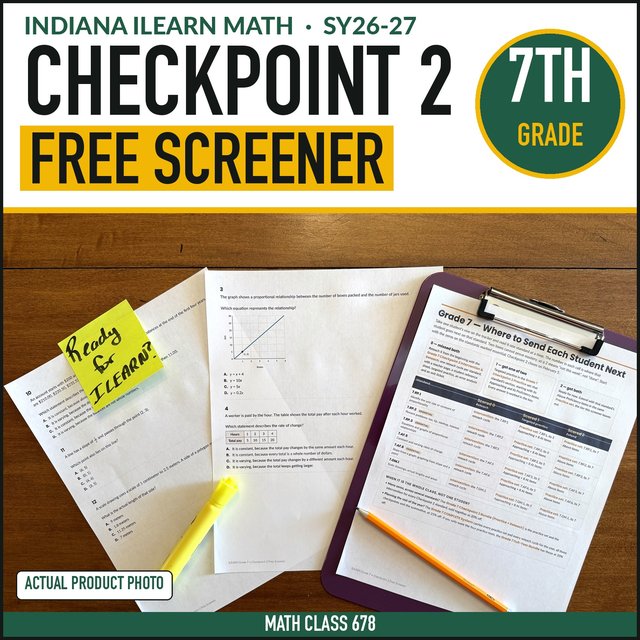
The grade 7 screener: two items per standard, a class tracker and a page that says where each student goes next.

Get it free
120 items · 68 pages

Checkpoint 2 Practice

120 practice items at three levels.

View on TPT
72 items · 55 pages

Checkpoint 2 Intervention & Reteach

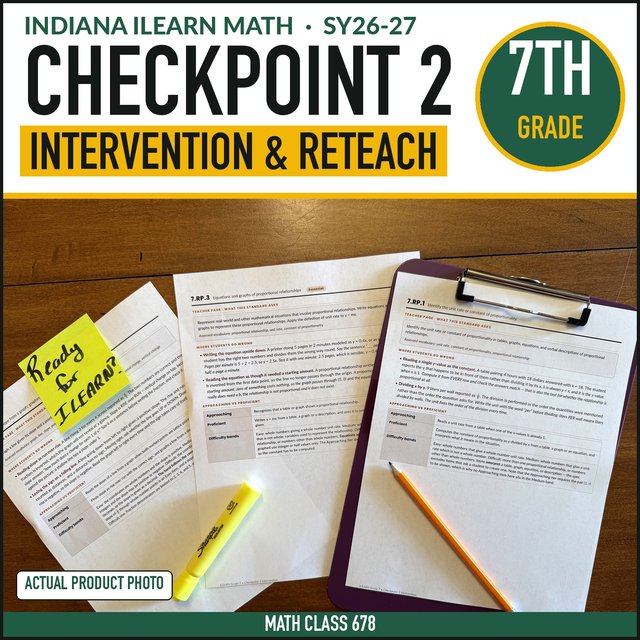
A teacher page, reteach page, practice, error analysis and exit ticket for each standard.

View on TPT
192 items · 123 pages

Checkpoint 2 Bundle

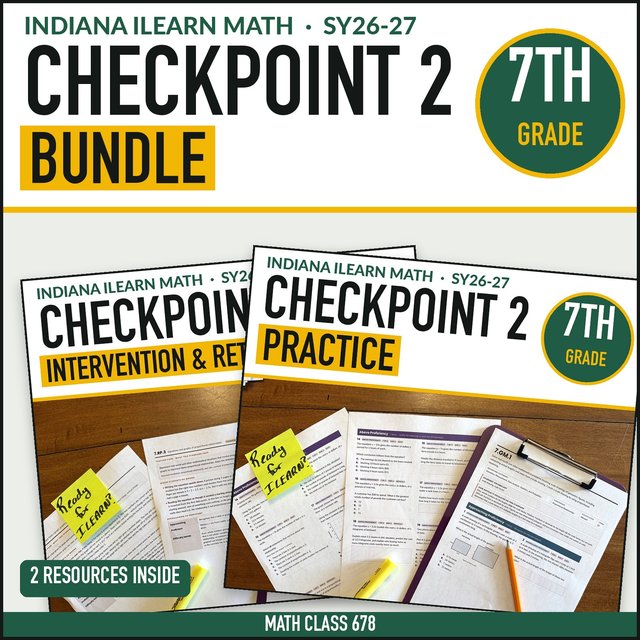
The practice set and the intervention together.

View on TPT

See inside the Checkpoint 2 practice

Press play for a 20-second look at the real pages.

Checkpoint 2 PracticeBefore the window opens
Checkpoint 2 Intervention & ReteachFor after the checkpoint
Checkpoint 2 BundlePractice and reteach together

Grade 7, window by window

Independent practiceIndependent practice for the Indiana ILEARN Math assessment. Not affiliated with, sponsored by, or endorsed by the Indiana Department of Education. Standard names are short summaries in our own words; see IDOE for the official text.