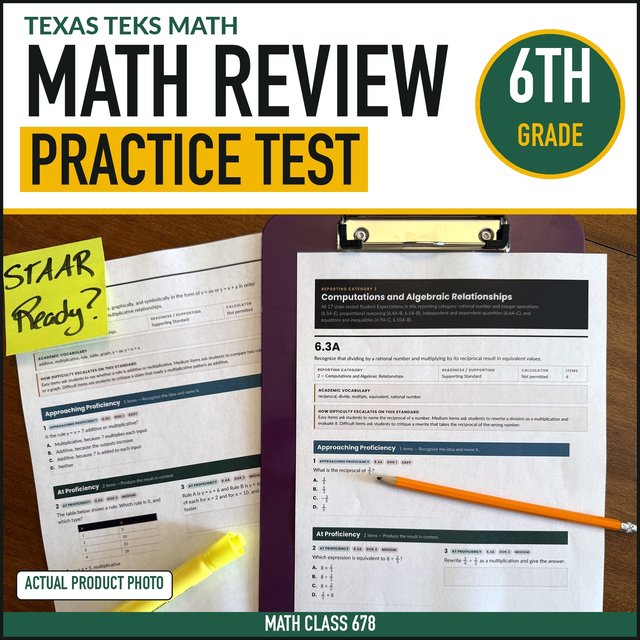
Grade 6 Texas TEKS Math Practice

Four reporting categories: Numerical Representations and Relationships; Computations and Algebraic Relationships; Geometry and Measurement; and Data Analysis and Personal Financial Literacy. Full-year practice for STAAR® test prep.

368practice items
51TEKS
4reporting categories
191pages

Your testing year

Where each part fits in the 2026-27 school year.

The testing year, in order
  1. 1Reporting Category 1: Numerical Representations and Relationshipsas you teach it
  2. 2Reporting Category 2: Computations and Algebraic Relationshipsas you teach it
  3. 3Reporting Category 3: Geometry and Measurementas you teach it
  4. 4Reporting Category 4: Data Analysis and Personal Financial Literacyas you teach it
  5. 5Full-length practice testspring

One download covers every step.

Cover of the Grade 6 Full-Year Practice

Full-year practice

Grade 6 Full-Year Practice

368 items · 191 pages · 51 standards

  • Start Here teacher guide
  • Reporting Category 1 Practice — Numerical Representations and Relationships: 92 items on 15 TEKS
  • Reporting Category 2 Practice — Computations and Algebraic Relationships: 116 items on 17 TEKS
  • Reporting Category 3 Practice — Geometry and Measurement: 48 items on 6 TEKS
  • Reporting Category 4 Practice — Data Analysis and Personal Financial Literacy: 76 items on 13 TEKS
  • Summative Mock practice test: 36 questions worth 43 points
  • Every practice item labeled Approaching, At or Above Proficiency, with a worked solution
  • Answer keys, an Item Analysis Sheet and a class roster in every practice set

Practice weighted like the test

Practice that gives every standard the same number of questions spends too long on standards that carry little of the test. These sets follow the weighting TEA publishes instead.

Assign each reporting-category set as you teach it, then give the practice test once everything has been taught.

12items on each of the 16 Readiness standards
4items on each of the 35 Supporting standards

For a whole team

For a team

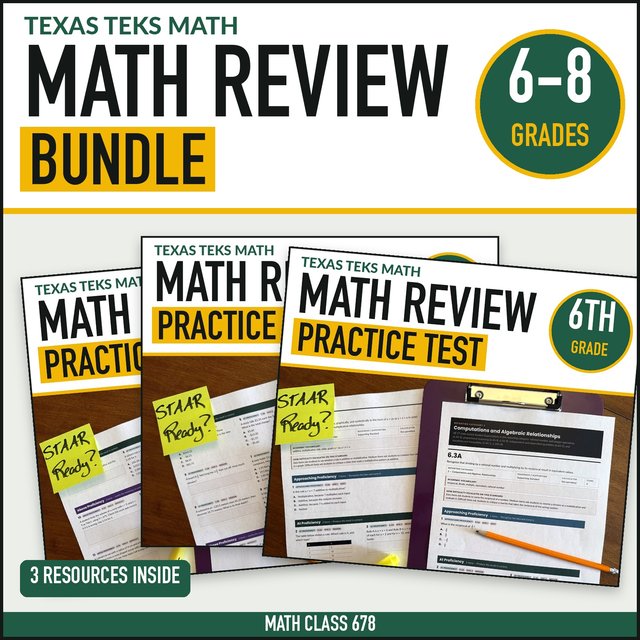
Grades 6–8 Bundle

Grades 6, 7 and 8 in one purchase.

View on TPT

What grade 6 covers

Short names in our own words. See TEA’s mathematics resources for the official standard text.

Numerical Representations and Relationships

  • 6.2AClassifying number sets with a Venn diagram
  • 6.2BA number, its opposite, and its absolute value
  • 6.2COrdering integers and rationals on a number line
  • 6.2DOrdering a set of rational numbers
  • 6.2EFraction notation as division
  • 6.4CRatios as multiplicative comparisons
  • 6.4DRates and unit rates
  • 6.4ERatios and percents as fractions and decimals
  • 6.4FBenchmark fractions and percents on models
  • 6.4GEquivalent fractions, decimals and percents
  • 6.5CEqual parts of the same whole
  • 6.7AOrder of operations, exponents and prime factorization
  • 6.7BExpressions versus equations
  • 6.7CDeciding whether two expressions are equivalent
  • 6.7DThe properties of operations

Computations and Algebraic Relationships

  • 6.3ADividing as multiplying by the reciprocal
  • 6.3BWhether multiplying increases or decreases a quantity
  • 6.3CModeling integer operations
  • 6.3DInteger fluency across the four operations
  • 6.3EMultiplying and dividing positive rational numbers
  • 6.4AComparing additive and multiplicative rules
  • 6.4BPrediction and comparison with ratios and rates
  • 6.5ARatio tables, graphs, proportions and scale factors
  • 6.5BPart, whole and percent problems
  • 6.6AIndependent and dependent quantities
  • 6.6BWriting an equation from a table
  • 6.6COne situation in four representations
  • 6.9AWriting one-step equations and inequalities
  • 6.9BGraphing solutions on a number line
  • 6.9CWriting the problem that matches an equation
  • 6.10ASolving one-step equations and inequalities
  • 6.10BTesting whether a value is a solution

Geometry and Measurement

  • 6.4HUnit conversion with proportions and unit rates
  • 6.8AAngle sum, side-angle order, and the triangle inequality
  • 6.8BDeriving area formulas by decomposing
  • 6.8CWriting area and volume equations
  • 6.8DSolving area and volume problems
  • 6.11AGraphing in all four quadrants

Data Analysis and Personal Financial Literacy

  • 6.12ABuilding dot plots, histograms and box plots
  • 6.12BCenter, spread and shape from a display
  • 6.12CMean, median, range and IQR
  • 6.12DMode, relative frequency and the percent bar graph
  • 6.13AInterpreting statistical displays
  • 6.13BData with and without variability
  • 6.14AChecking accounts and debit cards
  • 6.14BDebit cards versus credit cards
  • 6.14CBalancing a check register
  • 6.14EWhat a credit report contains
  • 6.14FThe value of credit reports
  • 6.14GWays to pay for college
  • 6.14HSalary, training and lifetime income

Try three items

Pick an answer to see the worked solution.

6.2BApproaching

What is the opposite of −9?

Choose an answer to see the worked solution.

6.3AAt Proficiency

Which expression is equivalent to 8 ÷ 23?

Choose an answer to see the worked solution.

6.4HAt Proficiency

A recipe needs 3 pints of stock. A cook has 4 cups. How many more cups are needed?

Choose an answer to see the worked solution.

Teacher questions

When should I use each part?

Assign each practice set as you teach its topics, then give the full-length practice test once everything has been taught.

What about calculators?

The practice follows the state's calculator rule for this grade: not permitted. Check your school's testing guidance for the current rules.

Are these actual state test questions?

No. Every item is original and aligned to the published standards. Nothing is copied from a state test, a released item or a reference sheet.

Other Texas grades and courses

Independent practiceSTAAR® is a federally registered trademark of the Texas Education Agency, which does not sponsor or endorse this resource. Math Class 678 is not affiliated with TEA. Standard names on this page are short summaries in our own words.