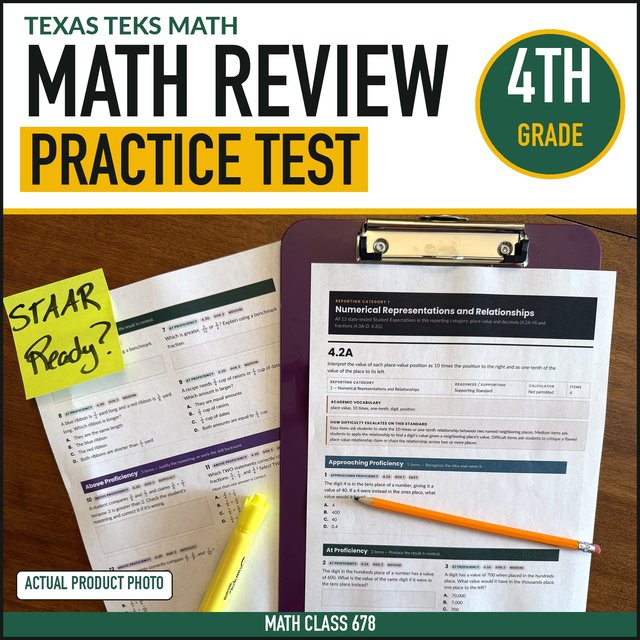
Grade 4 Texas TEKS Math Practice

Four reporting categories: Numerical Representations and Relationships; Computations and Algebraic Relationships; Geometry and Measurement; and Data Analysis and Personal Financial Literacy. Full-year practice for STAAR® test prep.

300practice items
41TEKS
4reporting categories
166pages

Your testing year

Where each part fits in the 2026-27 school year.

The testing year, in order
  1. 1Reporting Category 1: Numerical Representations and Relationshipsas you teach it
  2. 2Reporting Category 2: Computations and Algebraic Relationshipsas you teach it
  3. 3Reporting Category 3: Geometry and Measurementas you teach it
  4. 4Reporting Category 4: Data Analysis and Personal Financial Literacyas you teach it
  5. 5Full-length practice testspring

One download covers every step.

Cover of the Grade 4 Full-Year Practice

Full-year practice

Grade 4 Full-Year Practice

300 items · 166 pages · 41 standards

  • Start Here teacher guide
  • Reporting Category 1 Practice — Numerical Representations and Relationships: 76 items on 13 TEKS
  • Reporting Category 2 Practice — Computations and Algebraic Relationships: 88 items on 12 TEKS
  • Reporting Category 3 Practice — Geometry and Measurement: 76 items on 11 TEKS
  • Reporting Category 4 Practice — Data Analysis and Personal Financial Literacy: 28 items on 5 TEKS
  • Summative Mock practice test: 32 questions worth 40 points
  • Every practice item labeled Approaching, At or Above Proficiency, with a worked solution
  • Answer keys, an Item Analysis Sheet and a class roster in every practice set

Practice weighted like the test

Practice that gives every standard the same number of questions spends too long on standards that carry little of the test. These sets follow the weighting TEA publishes instead.

Assign each reporting-category set as you teach it, then give the practice test once everything has been taught.

12items on each of the 13 Readiness standards
4items on each of the 28 Supporting standards

For a whole team

For a team

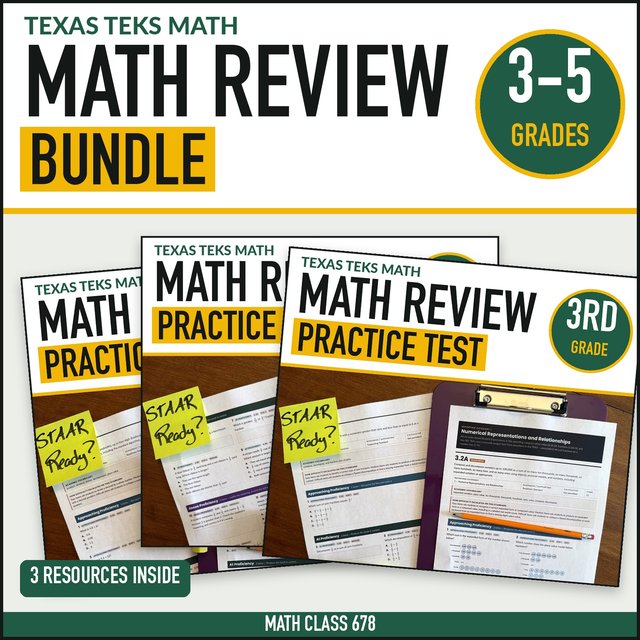
Grades 3–5 Bundle

Grades 3, 4 and 5 in one purchase.

View on TPT

What grade 4 covers

Short names in our own words. See TEA’s mathematics resources for the official standard text.

Numerical Representations and Relationships

  • 4.2A10-times / one-tenth place-value relationship
  • 4.2BExpanded notation for whole numbers and decimals to hundredths
  • 4.2CCompare/order whole numbers to 1,000,000,000
  • 4.2DRound whole numbers through the hundred thousands place
  • 4.2ERepresent decimals with models and money
  • 4.2FCompare/order decimals to the hundredths
  • 4.2GRelate decimals to tenths/hundredths fractions
  • 4.2HDecimal from a number-line point (tenths/hundredths)
  • 4.3AFraction a/b as a sum of unit fractions
  • 4.3BDecompose a fraction multiple ways (same denominator)
  • 4.3CDetermine if two fractions are equivalent
  • 4.3DCompare fractions with different numerators/denominators
  • 4.3GFractions/decimals as distances from zero on a number line

Computations and Algebraic Relationships

  • 4.3EAdd/subtract fractions with equal denominators
  • 4.3FReasonableness of fraction sums/differences using benchmarks
  • 4.4AStandard algorithm add/subtract, whole numbers and decimals
  • 4.4BMultiply a number by 10 or 100 using place value
  • 4.4CRepresent a 2-digit x 2-digit product (arrays/area models)
  • 4.4DMultiply up to 4-digit x 1-digit and 2-digit x 2-digit
  • 4.4ERepresent a quotient (up to 4-digit ÷ 1-digit)
  • 4.4FStandard algorithm division, up to 4-digit ÷ 1-digit
  • 4.4GRound or use compatible numbers to estimate
  • 4.4HFluent 1-/2-step multiplication and division, remainders
  • 4.5AStrip diagrams and equations for multi-step problems
  • 4.5BInput-output tables and number patterns

Geometry and Measurement

  • 4.5DPerimeter and area of rectangles (whole-number dimensions)
  • 4.6APoints, lines, segments, rays, angles, parallel/perpendicular lines
  • 4.6BLines of symmetry for a 2-D figure
  • 4.6CClassify triangles as acute, right, or obtuse
  • 4.6DClassify quadrilaterals by parallel/perpendicular sides and angles
  • 4.7CRead an angle's measure in degrees with a protractor
  • 4.7DDraw/identify an angle with a given measure
  • 4.7EUnknown angle from two non-overlapping adjacent angles
  • 4.8ARelative sizes of customary/metric measurement units
  • 4.8BConvert measurements within a system using a table
  • 4.8CMeasurement word problems: length, time, volume, mass, money

Data Analysis and Personal Financial Literacy

  • 4.9ARepresent data on a frequency table, dot plot, or stem-and-leaf plot
  • 4.9BSolve one-/two-step problems using data (whole number, decimal, fraction)
  • 4.10ADistinguish fixed vs. variable expenses
  • 4.10BCalculate profit (revenue minus expenses)
  • 4.10EDescribe the basic purpose of financial institutions

Try three items

Pick an answer to see the worked solution.

4.2AApproaching

The digit 4 is in the tens place of a number, giving it a value of 40. If a 4 were instead in the ones place, what value would it have?

Choose an answer to see the worked solution.

4.3EAt Proficiency

A recipe calls for 56 cup of flour for muffins and 46 cup of flour for a glaze. How much flour is used in total?

Choose an answer to see the worked solution.

4.5DAt Proficiency

A rectangular fence encloses a yard that is 15 meters long and 10 meters wide. How many meters of fencing are needed to go all the way around the yard?

Choose an answer to see the worked solution.

Teacher questions

When should I use each part?

Assign each practice set as you teach its topics, then give the full-length practice test once everything has been taught.

What about calculators?

The practice follows the state's calculator rule for this grade: not permitted. Check your school's testing guidance for the current rules.

Are these actual state test questions?

No. Every item is original and aligned to the published standards. Nothing is copied from a state test, a released item or a reference sheet.

Other Texas grades and courses

Independent practiceSTAAR® is a federally registered trademark of the Texas Education Agency, which does not sponsor or endorse this resource. Math Class 678 is not affiliated with TEA. Standard names on this page are short summaries in our own words.