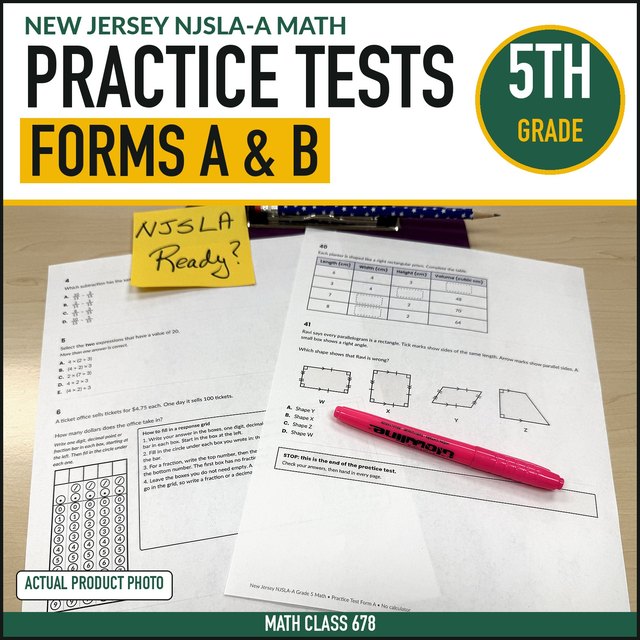
Grade 5 New Jersey NJSLA Math Practice
Grade 5 practice covers the 26 standards of New Jersey’s 2023 grade 5 math standards, in the NJSLA-A’s four reporting categories: Number and Operations in Base Ten; Number and Operations - Fractions; Operations and Algebraic Thinking & Measurement; and Geometry and Data Literacy. The spring test has 41 items in two sessions of about 75 minutes, in multiple choice, multi-select, response boxes, tables and graphic answers. No calculator.
 Designed, reviewed, and checked by Greg · 25+ years in the classroom · Updated for 2026-27
26standards
4reporting categories
300pages
Free Start with the free Grade 5 screener: 15 questions and a table that says which reporting category each student needs first.
Your testing year
Where each part fits in the 2026-27 school year.
- 1Practice and reteach by domainas you teach it
- 2Practice Test Form Amidyear, scored by category
- 320-day countdownthe last 20 school days
- 4Practice Test Form Bjust before the test
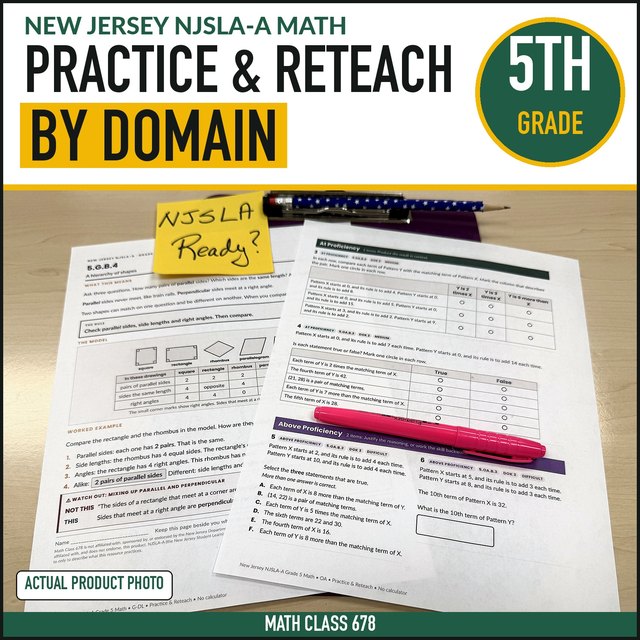
Practice & Reteach by Domain
174 pages · 26 standardsView on TPT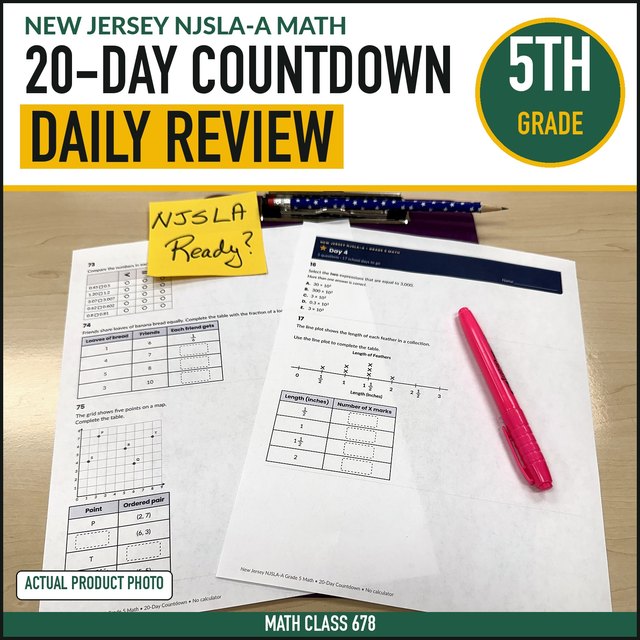
20-Day Countdown Review
100 items · 66 pagesView on TPTSave with a bundle
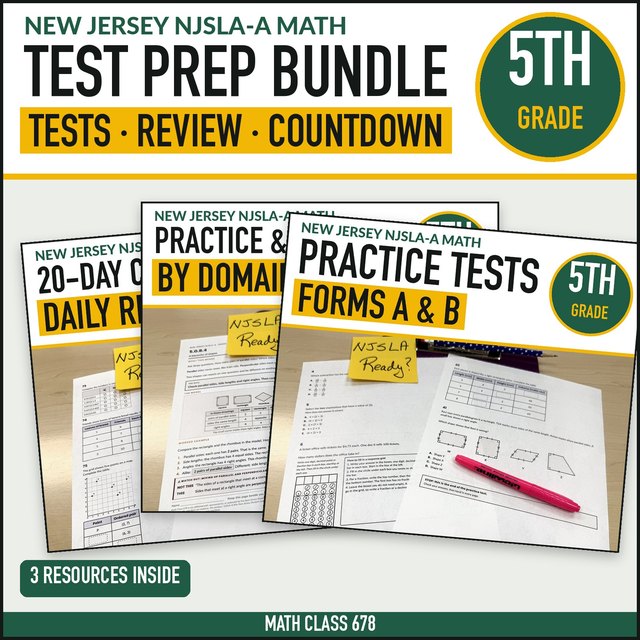
See inside the grade 5 practice
Press play for a 20-second look at the real pages.
How the grade 5 test is weighted
The number of items in each reporting category on the grade 5 NJSLA-A, from New Jersey’s published math blueprint.
Number and Operations in Base Ten
11–14 of 41 items
Number and Operations - Fractions
11–14 of 41 items
Operations and Algebraic Thinking & Measurement
10–12 of 41 items
Geometry and Data Literacy
6–8 of 41 items
What grade 5 covers
Short names in our own words. See New Jersey’s 2023 grade 5 mathematics standards for the official standard text.
Operations and Algebraic Thinking
- 5.OA.A.1Parentheses, brackets and braces
- 5.OA.A.2Writing and reading expressions
- 5.OA.B.3Two patterns and their ordered pairs
Number and Operations in Base Ten
- 5.NBT.A.1Place value: ten times and one tenth
- 5.NBT.A.2Powers of 10 and the decimal point
- 5.NBT.A.3Reading, writing and comparing decimals
- 5.NBT.A.4Rounding decimals
- 5.NBT.B.5Multiplying with the standard algorithm
- 5.NBT.B.6Dividing by two-digit divisors
- 5.NBT.B.7Operations with decimals to hundredths
Number and Operations - Fractions
- 5.NF.A.1Adding and subtracting unlike fractions
- 5.NF.A.2Fraction word problems and estimating
- 5.NF.B.3A fraction as division
- 5.NF.B.4Multiplying by a fraction
- 5.NF.B.5Multiplication as scaling
- 5.NF.B.6Fraction and mixed-number word problems
- 5.NF.B.7Dividing with unit fractions
Measurement
- 5.M.A.1Converting units
- 5.M.B.2What volume is
- 5.M.B.3Volume by counting unit cubes
- 5.M.B.4Volume of rectangular prisms
Geometry and Data Literacy
- 5.DL.B.5Line plots of fraction measurements
- 5.G.A.1The coordinate plane
- 5.G.A.2Graphing points to solve problems
- 5.G.B.3Attributes of shape categories
- 5.G.B.4A hierarchy of shapes
Try three items
Pick an answer to see the worked solution.
Which expression shows "add 11 and 7, then divide by 3"?
Choose an answer to see the worked solution.
Worked solutionThe sum is found before the dividing, so 11 + 7 goes in parentheses and the sum is divided by 3. Without parentheses, only the 7 is divided by 3. Dividing 11 by 3 and adding 7 divides only the 11, and 11 − 7 subtracts instead of adding.
Which statement correctly explains why 52 ÷ 102 = 0.52?
Choose an answer to see the worked solution.
Worked solutionDividing by 102 makes every digit worth 1100 as much, so each digit moves 2 places to the right: the 5 goes from the tens place to the tenths place and the 2 from the ones place to the hundredths place. Moving left would make the number larger. 52 has no zeros to take off, and moving only 1 place is dividing by 10.
Which fraction is the same amount as 4 ÷ 11?
Choose an answer to see the worked solution.
Worked solutionA fraction is a division: the number being divided is the numerator and the number it is divided by is the denominator. 4 ÷ 11 is 411. 114 turns the division upside down. 47 subtracts and 1511 adds, and neither one divides.
Teacher questions
When should I use each part?
Assign each practice set as you teach its topics, then give the full-length practice test once everything has been taught.
What about calculators?
The practice follows the state's calculator rule for this grade: no calculator. Check your school's testing guidance for the current rules.
Are these actual state test questions?
No. Every item is original and aligned to the published standards. Nothing is copied from a state test, a released item or a reference sheet.
Other New Jersey grades and courses
Independent practiceIndependent practice for the New Jersey Student Learning Assessment (NJSLA) in mathematics. Not affiliated with, sponsored by, or endorsed by the New Jersey Department of Education. Standard names on this page are short summaries in our own words.