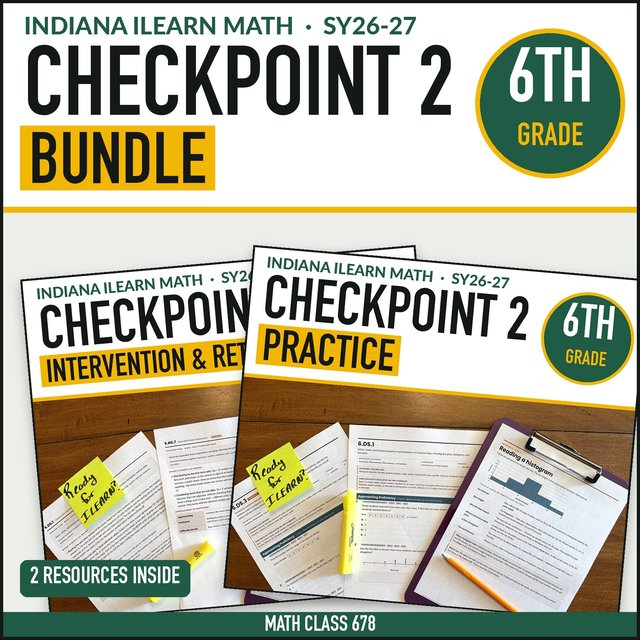
Grade 6 ILEARN Math Checkpoint 2 Practice

What Checkpoint 2 covers in grade 6, items to try, the mistakes students make most, and the practice that goes with it.

7standards
140practice items

What Checkpoint 2 covers

7 standards, 5 marked essential. Short names in our own words.

  • 6.NS.7Equivalent expressions; like termsEssential
  • 6.AF.1Write and evaluate expressions with variablesEssential
  • 6.AF.2Test whether a value is a solutionEssential
  • 6.AF.3Solve one-step equationsEssential
  • 6.AF.4Write and graph inequalities
  • 6.DS.1Select, create, and interpret data displays
  • 6.DS.3Summarize data: center, spread, shapeEssential

Try three items

Pick an answer to see the worked solution.

6.AF.4Approaching

Which inequality is shown on the number line?

Choose an answer to see the worked solution.

6.NS.7At Proficiency

Which expression is equivalent to 2(3x + 1) + 4x?

Choose an answer to see the worked solution.

6.AF.2Above Proficiency

A ride requires riders to be at least 48 inches tall. Four students measure 45, 47.5, 48, and 51 inches. Using h ≥ 48, how many of them may ride?

Choose an answer to see the worked solution.

Where students go wrong

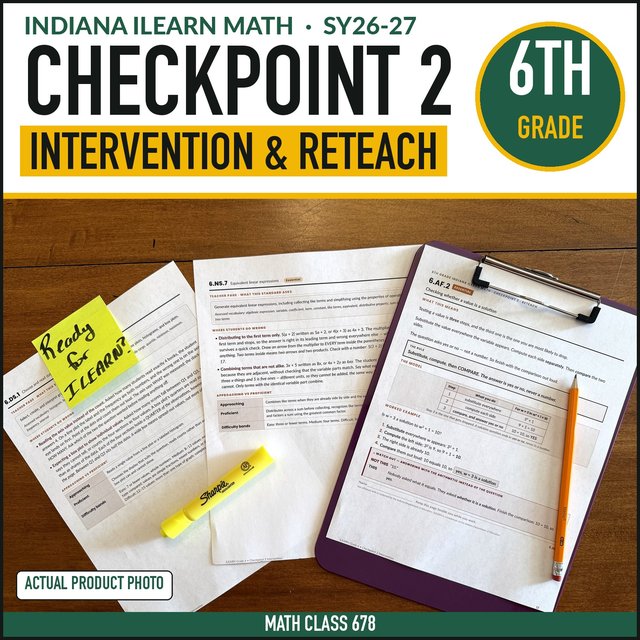
The most common mistake on each standard, and what to do about it, from the teacher pages in the Checkpoint 2 intervention.
6.NS.7

Distributing to the first term only

What it looks like
5(a + 2) written as 5a + 2, or 4(x + 3) as 4x + 3. The multiplier reaches the first term and stops, so the answer is right in its leading term and wrong everywhere else — which is why it survives a quick check.
What to do
Draw an arrow from the multiplier to EVERY term inside the parentheses before writing anything. Two terms inside means two arrows and two products. Check with a number: 5(3 + 2) is 25, and 5(3) + 2 is 17.
6.AF.1

Reading an exponent as multiplication by the exponent

What it looks like
n2 evaluated at n = 6 as 12. The student reads the small 2 as “times 2”, which agrees with the right answer only at n = 2 — so it can survive a long stretch of practice.
What to do
Read the exponent aloud as a count of factors: n2 is n times n. Write the repeated multiplication out in full before substituting any number.
6.AF.2

Substituting, then answering the arithmetic instead of the question

What it looks like
Asked whether w = 3 solves w2 + 1 = 10, the student writes 10 and stops, or answers “10” rather than yes. The substitution is correct and the question is never answered.
What to do
Finish with the comparison out loud: “10 equals 10, so yes.” A solution question always ends in yes or no, never in a number.
6.AF.3

Applying the same operation instead of the inverse

What it looks like
k ÷ 4 = 2.5 solved by dividing again, giving 0.625; or x − 7 = 15 solved by subtracting 7, giving 8. The student repeats the operation they see rather than undoing it.
What to do
Name the operation that is happening TO the variable, then name its opposite before touching the equation. Divided by 4 is undone by multiplying by 4. Always substitute the answer back: 0.625 ÷ 4 is not 2.5, and the check catches it.
6.AF.4

Open and closed circles chosen by the direction of the sign

What it looks like
x ≤ 6 graphed with an open circle, or h ≥ 48 described as excluding 48 — “the sign says greater, so 48 is not included.” The shading is usually right and the endpoint is wrong.
What to do
The circle is decided by the LINE under the symbol and nothing else: a line means “or equal to”, which means the endpoint counts, which means filled in. Direction is a separate decision made after.
6.DS.1

Reading the axis value instead of the count

What it looks like
Asked how many students read exactly 4 books, the student answers 4. On a line plot the label and the frequency are both numbers, and the wrong one is on the axis the eye lands on first.
What to do
Point at the dots and count them out loud. The axis says WHAT was measured; the stack says HOW MANY. Ask which of the two the question wanted before reading anything off.
6.DS.3

Swapping the interquartile range and the range

What it looks like
Asked for both, the student gives the range twice, or reports the IQR as the distance between the whiskers. Both are subtractions on the same picture, so the arithmetic is right and the labels are exchanged.
What to do
The IQR measures the BOX and the range measures the WHISKERS. Trace each one with a finger before subtracting, and say which two numbers you are using.

Get the Checkpoint 2 practice

Free

Try it first

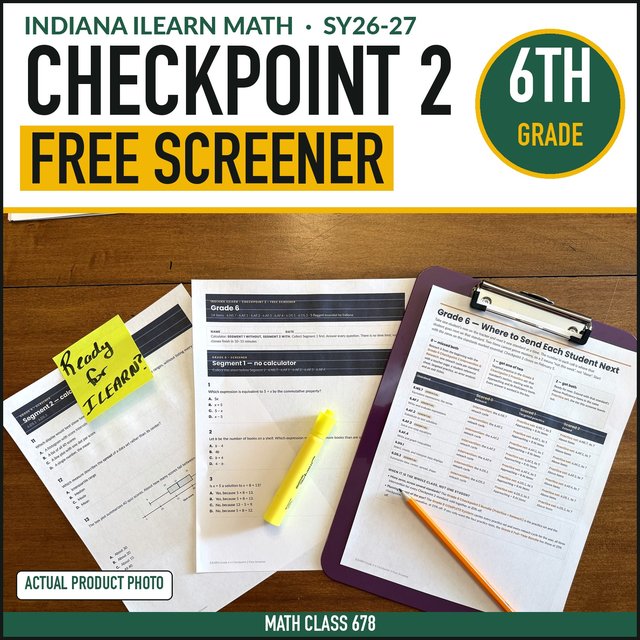
The grade 6 screener: two items per standard, a class tracker and a page that says where each student goes next.

Get it free
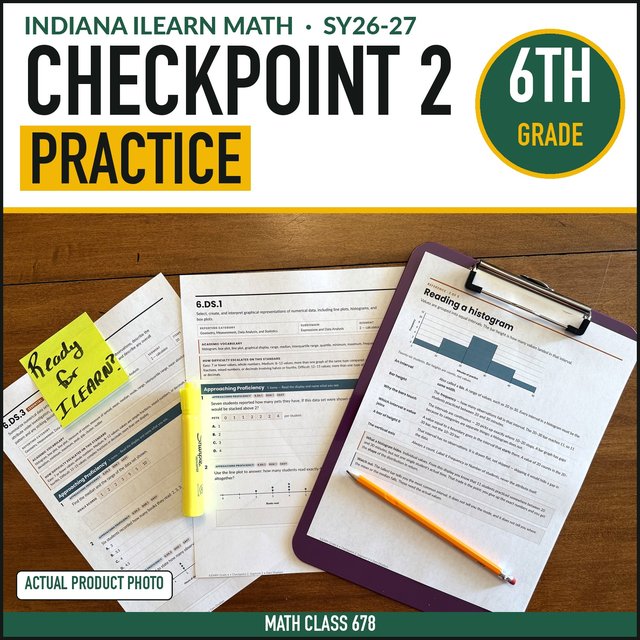
140 items · 71 pages

Checkpoint 2 Practice

140 practice items at three levels.

View on TPT
84 items · 58 pages

Checkpoint 2 Intervention & Reteach

A teacher page, reteach page, practice, error analysis and exit ticket for each standard.

View on TPT
224 items · 129 pages

Checkpoint 2 Bundle

The practice set and the intervention together.

View on TPT

See inside the Checkpoint 2 practice

Press play for a 20-second look at the real pages.
Checkpoint 2 PracticeBefore the window opens
Checkpoint 2 Intervention & ReteachFor after the checkpoint
Checkpoint 2 BundlePractice and reteach together

Grade 6, window by window

Independent practiceIndependent practice for the Indiana ILEARN Math assessment. Not affiliated with, sponsored by, or endorsed by the Indiana Department of Education. Standard names are short summaries in our own words; see IDOE for the official text.