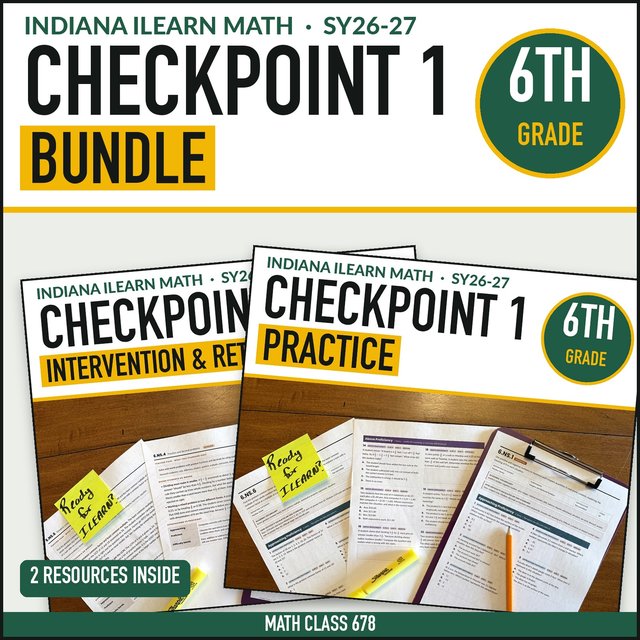
Grade 6 ILEARN Math Checkpoint 1 Practice

What Checkpoint 1 covers in grade 6, items to try, the mistakes students make most, and the practice that goes with it.

6standards
120practice items
22item mock form
Nocalculator

What Checkpoint 1 covers

6 standards, 4 marked essential. Short names in our own words.

  • 6.NS.1Signed numbers in context; meaning of 0Essential
  • 6.NS.3Compare and order rational numbers
  • 6.NS.4Real-world fraction and decimal problemsEssential
  • 6.NS.5Order of operations and propertiesEssential
  • 6.NS.6GCF, LCM, distributive property
  • 6.RP.1Fraction, decimal, percent conversionEssential

Try three items

Pick an answer to see the worked solution.

6.NS.5Approaching

Which value is equal to 20 − (6 × 2)?

Choose an answer to see the worked solution.

6.NS.6At Proficiency

What is the greatest common factor of 91 and 65?

Choose an answer to see the worked solution.

6.NS.1At Proficiency

Three bank transactions are recorded as −12.50, 8.75, and −12.05. Which transaction represents the largest withdrawal?

Choose an answer to see the worked solution.

Where students go wrong

The most common mistake on each standard, and what to do about it, from the teacher pages in the Checkpoint 1 intervention.
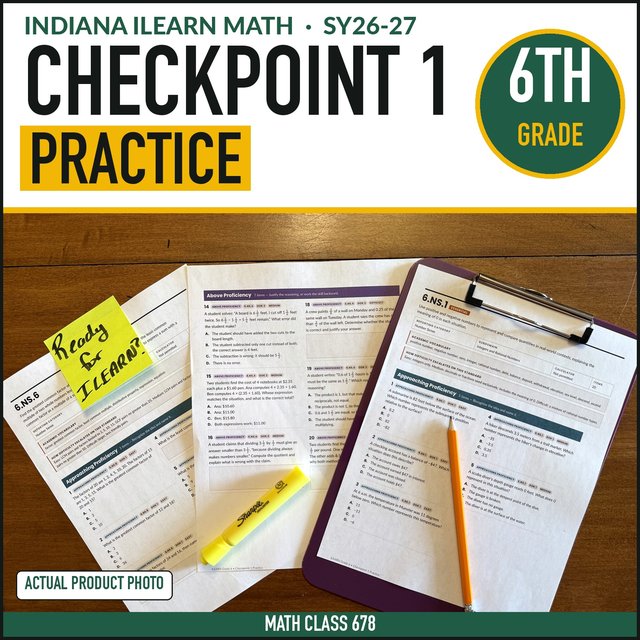
6.NS.1

Reading a negative by its digits

What it looks like
−20°F called warmer than −5°F, because 20 is bigger than 5. The student compares the numerals and ignores the sign, so every negative comparison comes out backwards — and it looks like a careless slip rather than a rule being applied consistently.
What to do
Ask “which one would you rather stand in?” before any symbol is written. Then put both on a line with 0 marked. Colder, lower, further in debt all mean further LEFT, and left is always less.
6.NS.3

Ordering negatives by distance from zero

What it looks like
−7, −6.55, −6.5 written in the order −6.5, −6.55, −7. The student orders the digits as if the numbers were positive, so the list comes out exactly reversed.
What to do
For negatives, further from zero is SMALLER. Order the numbers as positives first, then flip the whole list. Doing it in two deliberate steps beats trying to hold the reversal in your head while comparing.
6.NS.4

Dividing must make it smaller

What it looks like
412 ÷ 34 answered as about 3, or the student multiplies instead because the answer “should” be less than 412. Dividing by a number below 1 produces MORE pieces, which contradicts the rule they carried up from whole numbers.
What to do
Ask what the question counts: how many 34-yard pieces fit in 412 yards? Pieces smaller than a yard means more than 412 of them. Estimate the count BEFORE computing, so an answer of 3 is rejected on sight.
6.NS.5

Working strictly left to right

What it looks like
4 + 3 × (9 − 5) answered as 28: the student does 4 + 3 first, then multiplies by 4. The grouping symbols were handled correctly, which is what makes this look like a computation slip instead of an ordering error.
What to do
Number the steps on the page before computing any of them — grouping, then exponents, then all multiply and divide left to right, then all add and subtract. Writing 1, 2, 3 above the operations costs five seconds and removes the guess.
6.NS.6

Swapping greatest common factor and least common multiple

What it looks like
The least common multiple of 4 and 6 answered as 2, or the GCF of 12 and 18 answered as 36. The student computes carefully and reports the other quantity; the arithmetic is right and the question was misread.
What to do
Factors go INTO the number and are never bigger than it; multiples come OUT of it and are never smaller. Ask “am I looking for something that fits inside, or something both can reach?” before starting.
6.RP.1

Moving the decimal point without knowing which way

What it looks like
0.23 written as 0.0023%, or 45% as 450. The student has learned “two places” without attaching a direction to it, so half the conversions come out right by luck.
What to do
Anchor on one fact instead of a rule: 0.5 is 50%. Check every conversion against it. Percent numbers are the bigger-looking ones, because a percent counts hundredths.

Get the Checkpoint 1 practice

Free

Try it first

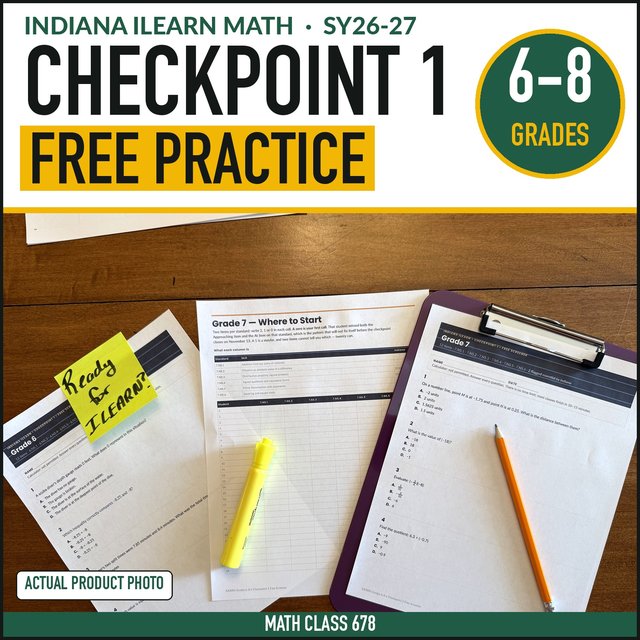
The Grades 6-8 screener: two items per standard and a class tracker.

Get it free
142 items · 39 pages

Checkpoint 1 Practice + Mock Form

120 practice items at three levels, plus a 22-item mock form.

View on TPT
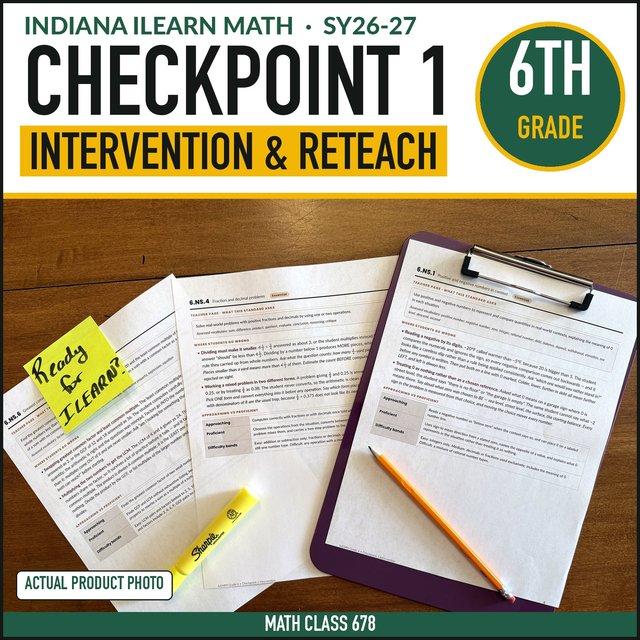
72 items · 46 pages

Checkpoint 1 Intervention & Reteach

A teacher page, reteach page, practice, error analysis and exit ticket for each standard.

View on TPT
214 items · 88 pages

Checkpoint 1 Bundle

The practice set and the intervention together.

View on TPT

See inside the Checkpoint 1 practice

Press play for a 20-second look at the real pages.
Checkpoint 1 Practice + Mock FormBefore the window opens
Checkpoint 1 Intervention & ReteachFor after the checkpoint
Checkpoint 1 BundlePractice and reteach together

Grade 6, window by window

Independent practiceIndependent practice for the Indiana ILEARN Math assessment. Not affiliated with, sponsored by, or endorsed by the Indiana Department of Education. Standard names are short summaries in our own words; see IDOE for the official text.