Pennsylvania Keystone Algebra I Practice
Keystone Algebra I practice covers the eligible content in Pennsylvania’s six Algebra I assessment anchors, across the exam’s two modules: Operations and Linear Equations & Inequalities, and Linear Functions and Data Organization. Each module has 18 multiple-choice questions and 3 constructed-response tasks scored 0 to 4, and a calculator is allowed on every question.
 Designed, reviewed, and checked by Greg · 25+ years in the classroom · Updated for 2026-27
33eligible content codes
2modules
476pages
Free Start with the free Algebra I screener: 12 questions and a table that says which assessment anchor each student needs first.
Your testing year
Where each part fits in the 2026-27 school year.
- 1Practice by assessment anchoras you teach it
- 2One constructed-response task a weekalongside the practice
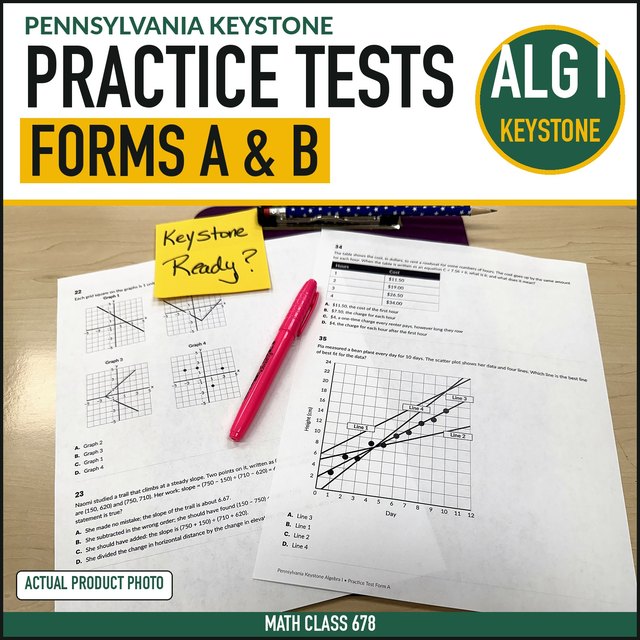
- 3Practice Test Form Aabout a month before the test
- 420-day countdownthe last 20 school days
- 5Practice Test Form Bthe last week or two

Anchor Practice & Reteach
287 pages · 33 standardsView on TPT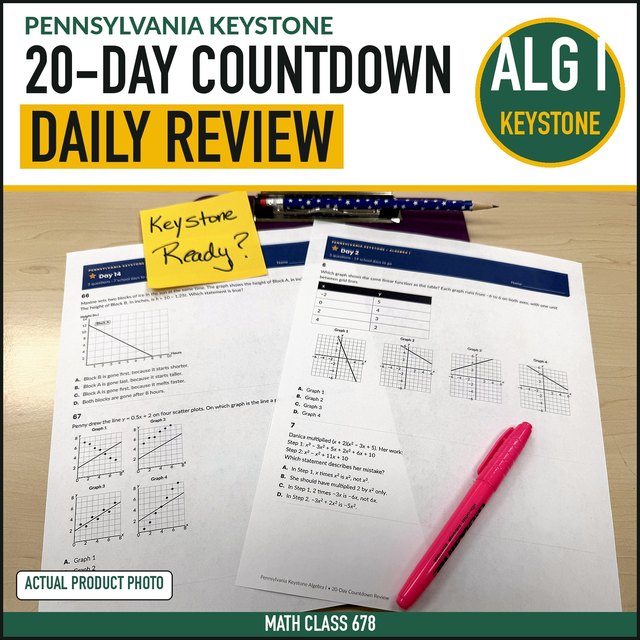
20-Day Countdown Review
105 items · 65 pagesView on TPT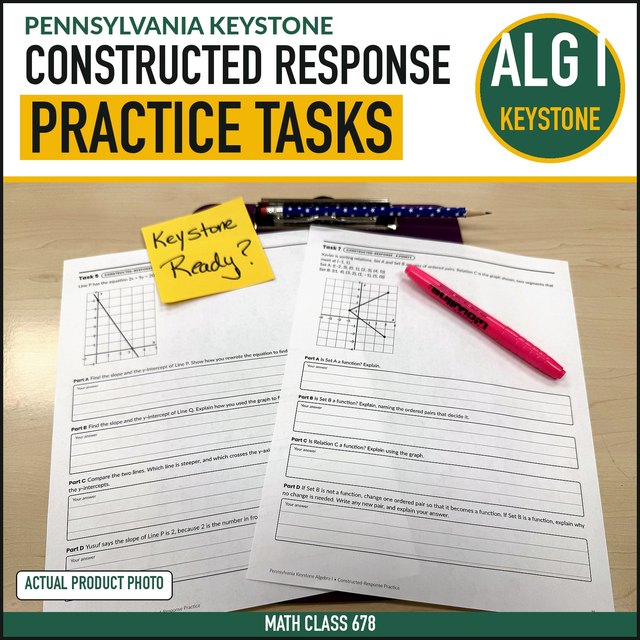
Constructed-Response Practice
12 items · 34 pagesView on TPTFor a whole team

See inside the Algebra I practice
Press play for a 20-second look at the real pages.
How the Algebra I test is weighted
The Keystone Algebra I exam’s two modules, each 30 of the 60 points (18 multiple-choice questions and 3 constructed-response tasks), with the assessment anchors each one covers.
Module 1: Operations and Linear Equations & Inequalities
30 of 60 points
A1.1.1 Operations with Real Numbers and Expressions · A1.1.2 Linear Equations · A1.1.3 Linear Inequalities
Module 2: Linear Functions and Data Organization
30 of 60 points
A1.2.1 Functions · A1.2.2 Coordinate Geometry · A1.2.3 Data Analysis
What Algebra I covers
Short names in our own words. See Pennsylvania’s Keystone Algebra I module blueprint for the official standard text.
A1.1.1 Operations with Real Numbers and Expressions
- A1.1.1.1.1Compare and order real numbers
- A1.1.1.1.2Simplify square roots
- A1.1.1.2.1Greatest common factor and least common multiple of monomials
- A1.1.1.3.1Laws of exponents, roots and absolute value
- A1.1.1.4.1Estimating to solve problems
- A1.1.1.5.1Adding, subtracting and multiplying polynomials
- A1.1.1.5.2Factoring polynomials completely
- A1.1.1.5.3Reducing rational expressions to simplest form
A1.1.2 Linear Equations
- A1.1.2.1.1Writing and solving linear equations
- A1.1.2.1.2Properties that justify solving steps
- A1.1.2.1.3Interpreting a solution in context
- A1.1.2.2.1Solving systems of two linear equations
- A1.1.2.2.2Interpreting the solution of a system
A1.1.3 Linear Inequalities
- A1.1.3.1.1Compound and absolute value inequalities
- A1.1.3.1.2Linear inequalities on a number line
- A1.1.3.1.3Interpreting inequality solutions in situations
- A1.1.3.2.1Graphing a system of two inequalities
- A1.1.3.2.2Interpreting solutions of inequality systems
A1.2.1 Functions
- A1.2.1.1.1Representing a pattern in data
- A1.2.1.1.2Deciding whether a relation is a function
- A1.2.1.1.3Finding domain and range
- A1.2.1.2.1Making and using a linear function
- A1.2.1.2.2Moving between table, equation and graph
A1.2.2 Coordinate Geometry
- A1.2.2.1.1Constant rate of change
- A1.2.2.1.2Using slope to solve problems
- A1.2.2.1.3Writing the equation of a line
- A1.2.2.1.4Slope and y-intercept from equations and graphs
- A1.2.2.2.1Lines of best fit for scatter plots
A1.2.3 Data Analysis
- A1.2.3.1.1Range, quartiles and interquartile range
- A1.2.3.2.1Predictions from graphs and measures of center
- A1.2.3.2.2Analyzing data displays
- A1.2.3.2.3Predictions from a line of best fit
- A1.2.3.3.1Compound probability with and and or
Try three items
Pick an answer to see the worked solution.
Which number is the greatest?
Choose an answer to see the worked solution.
Worked solutionWrite each as a decimal: √17 is about 4.123 and 414 = 4.25. The greatest is 4.3. √17 is just over 4.12, since 4.122 = 16.9744. 414 is 4.25, less than 4.3. 4.12 is the least of the four.
A student rewrote 6 + 2x = 18 as 2x + 6 = 18. Which property justifies this step?
Choose an answer to see the worked solution.
Worked solutionThe two terms on the left changed order, so the commutative property of addition. The associative property changes grouping. Nothing was distributed. Nothing was added to both sides.
An elevator starts 90 feet above the lobby and goes down 6 feet each second. Inez solves 30 ≤ 90 − 6t ≤ 60 and gets 5 ≤ t ≤ 10. What does this mean?
Choose an answer to see the worked solution.
Worked solutiont is the time in seconds and 90 − 6t is the height. The height is from 30 to 60 feet when t is from 5 to 10. Reading 30 to 60 as seconds mixes up the time and the height. During the first 5 seconds the elevator is still more than 60 feet up. The speed is 6 feet each second.
Teacher questions
When should I use each part?
Assign each practice set as you teach its topics, then give the full-length practice test once everything has been taught.
What about calculators?
The practice follows the state's calculator rule for this course: a four-function, scientific or graphing calculator is allowed on every question, as on the keystone algebra i exam. Check your school's testing guidance for the current rules.
Are these actual state test questions?
No. Every item is original and aligned to the published standards. Nothing is copied from a state test, a released item or a reference sheet.
Other Pennsylvania grades and courses
Independent practiceIndependent practice for the Pennsylvania System of School Assessment (PSSA) and the Keystone Algebra I exam in mathematics. Not affiliated with, sponsored by, or endorsed by the Pennsylvania Department of Education. Standard names on this page are short summaries in our own words.