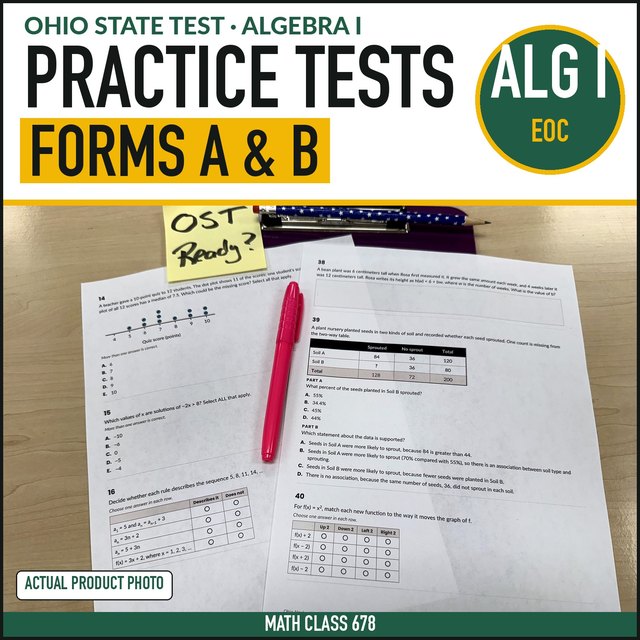
Ohio State Test Algebra I Practice
Algebra I practice covers the 43 standards on Ohio’s Algebra I blueprint in three reporting categories: Number, Quantities, Equations and Expressions; Functions; and Statistics. The end-of-course test has two parts, with a calculator on the whole test. It also counts toward graduation.
 Designed, reviewed, and checked by Greg · 25+ years in the classroom · Updated for 2026-27
531practice items
43standards
3reporting categories
420pages
Free Start with the free Algebra I screener: 12 questions and a table that says which reporting category each student needs first.
Your testing year
Where each part fits in the 2026-27 school year.
- 1Practice by reporting categoryas you teach it
- 2Practice Test Form Amidyear, scored by category
- 320-day countdownthe last 20 school days
- 4Practice Test Form Bjust before the test
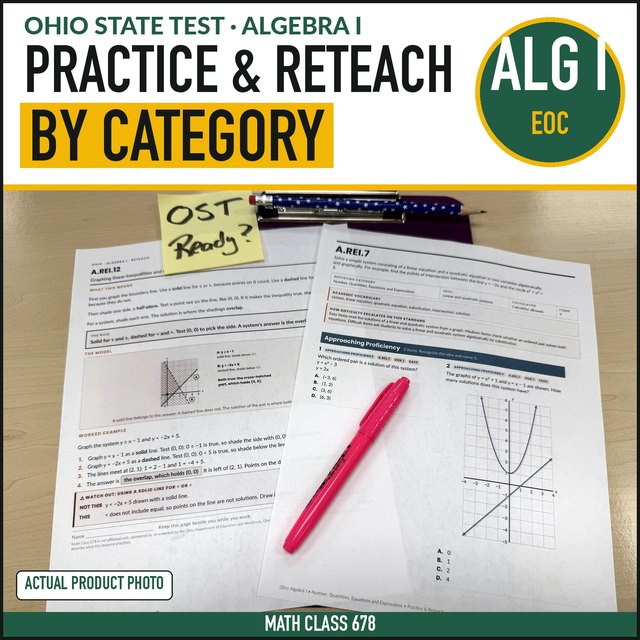
Category Practice & Reteach
331 items · 291 pages · 43 standardsView on TPT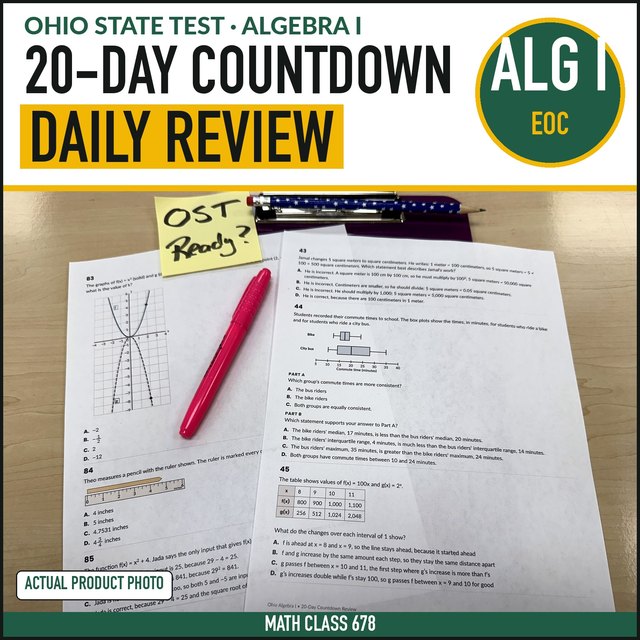
20-Day Countdown Review
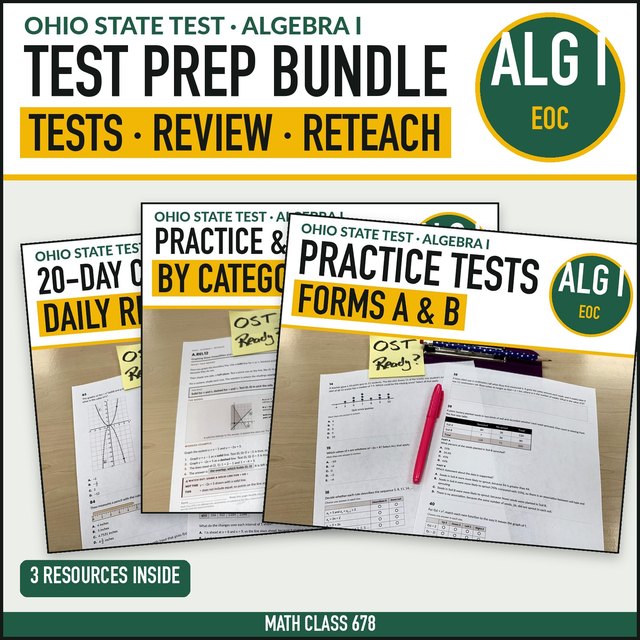
100 items · 59 pagesView on TPTSave with a bundle
See inside the Algebra I practice
Press play for a 20-second look at the real pages.
What Algebra I covers
Short names in our own words. See Ohio’s Learning Standards for Mathematics for the official standard text.
Number, Quantities, Equations and Expressions
- N.Q.1Units, scales and conversions
- N.Q.2Defining quantities for a model
- N.Q.3Choosing a level of accuracy
- A.SSE.1Interpreting parts of an expression
- A.SSE.2Rewriting expressions by structure
- A.SSE.3Equivalent forms that reveal features
- A.APR.1Adding and multiplying polynomials
- A.CED.1Writing equations in one variable
- A.CED.2Writing two-variable equations
- A.CED.3Constraints and viable solutions
- A.CED.4Rearranging formulas
- A.REI.1Justifying the steps of a solution
- A.REI.3Linear equations and inequalities
- A.REI.4Solving quadratic equations
- A.REI.7Linear and quadratic systems
Functions
- A.REI.5Combining equations in a system
- A.REI.6Solving systems of linear equations
- A.REI.10Graphs as sets of solutions
- A.REI.11Solving f(x) = g(x) with graphs
- A.REI.12Graphing linear inequalities
- F.IF.1Domain, range and functions
- F.IF.2Function notation
- F.IF.3Sequences as functions
- F.IF.4Key features of graphs
- F.IF.5Domain in context
- F.IF.7Graphing functions
- F.IF.8Forms that reveal properties
- F.IF.9Comparing functions
- F.BF.1Writing functions from context
- F.BF.2Arithmetic and geometric sequences
- F.BF.3Transforming quadratic graphs
- F.BF.4Finding an input from an output
- F.LE.1Linear or exponential growth
- F.LE.2Building linear and exponential models
- F.LE.3Exponential growth overtakes
- F.LE.5Parameters in context
Statistics
- S.ID.1Dot plots, histograms, box plots
- S.ID.2Comparing center and spread
- S.ID.3Shape, outliers and their effects
- S.ID.5Two-way frequency tables
- S.ID.6Scatter plots and lines of fit
- S.ID.7Slope and intercept in context
- S.ID.8The correlation coefficient
Try three items
Pick an answer to see the worked solution.
A pump moves water out of a flooded basement at a rate of 12 gallons per minute. The pump runs for 2.5 hours. How many gallons of water does it move?
Choose an answer to see the worked solution.
Worked solutionThe rate is in gallons per minute, so the time must be in minutes: 2.5 hours × 60 minutes per hour = 150 minutes. Then 12 gallons per minute × 150 minutes = 1,800 gallons; the minutes cancel and gallons are left. 30 gallons multiplies 12 by 2.5 without changing hours to minutes. 720 gallons is the amount for only 1 hour. 4.8 gallons divides 12 by 2.5, which does not give gallons at all.
The lines 2x + y = 7 and x − y = 2 cross at (3, 1). Adding the two equations gives 3x = 9, whose graph is the vertical line x = 3.
Which statement is true?
Choose an answer to see the worked solution.
Worked solutionEvery point that is on both original lines makes both equations true, so it makes their sum true too: (3, 1) gives 3(3) = 9. The new line x = 3 is a different line, but it passes through the same crossing point, and it crosses 2x + y = 7 only there (y = 7 − 6 = 1).
(9, 0) forgets to divide 9 by 3. A new line does not mean a new solution: it is drawn through the old crossing point. An equation with no y is a vertical line, which still crosses 2x + y = 7 exactly once.
(9, 0) forgets to divide 9 by 3. A new line does not mean a new solution: it is drawn through the old crossing point. An equation with no y is a vertical line, which still crosses 2x + y = 7 exactly once.
Data set A is 10, 12, 14, 16, 18. Data set B is the same five values plus one more value, 50.
Using the median of each half for the quartiles, how do the standard deviation and the interquartile range of B compare with those of A?
Choose an answer to see the worked solution.
Worked solutionFor A, Q1 is the median of 10, 12, which is 11, and Q3 is the median of 16, 18, which is 17, so the IQR is 6. For B the halves are 10, 12, 14 and 16, 18, 50, so Q1 = 12 and Q3 = 18: the IQR is still 6, because the quartiles only look at middle positions, not at how far the largest value is. The standard deviation measures distance from the mean, and 50 is 30 above B's mean of 20, so it jumps from about 3 to about 14 (technology gives 3.16 and 14.97 for the sample standard deviations).
One value is enough to move the standard deviation a lot, so “both stay the same” is wrong. The IQR, not the standard deviation, is the one that resists the outlier. 32 is how far 50 is from 18; neither statistic changes by that amount.
One value is enough to move the standard deviation a lot, so “both stay the same” is wrong. The IQR, not the standard deviation, is the one that resists the outlier. 32 is how far 50 is from 18; neither statistic changes by that amount.
Teacher questions
When should I use each part?
Assign each practice set as you teach its topics, then give the full-length practice test once everything has been taught.
What about calculators?
The practice follows the state's calculator rule for this course: a calculator on the whole test. Check your school's testing guidance for the current rules.
Are these actual state test questions?
No. Every item is original and aligned to the published standards. Nothing is copied from a state test, a released item or a reference sheet.
Other Ohio grades and courses
Independent practiceIndependent practice for Ohio’s State Tests in mathematics. Not affiliated with, sponsored by, or endorsed by the Ohio Department of Education and Workforce. Standard names on this page are short summaries in our own words.